Lab Testing for Men — The Optimization List and the Vanguard List
Compound Spotlight · Reference monograph
The short version
Most men are simultaneously over-tested and under-tested. Over-tested on the things influencer culture has convinced them matter (megadosing off a single low reading, ordering forty-panel “wellness” workups with no question in mind). Under-tested on the handful of markers that actually predict who lives longer and better.
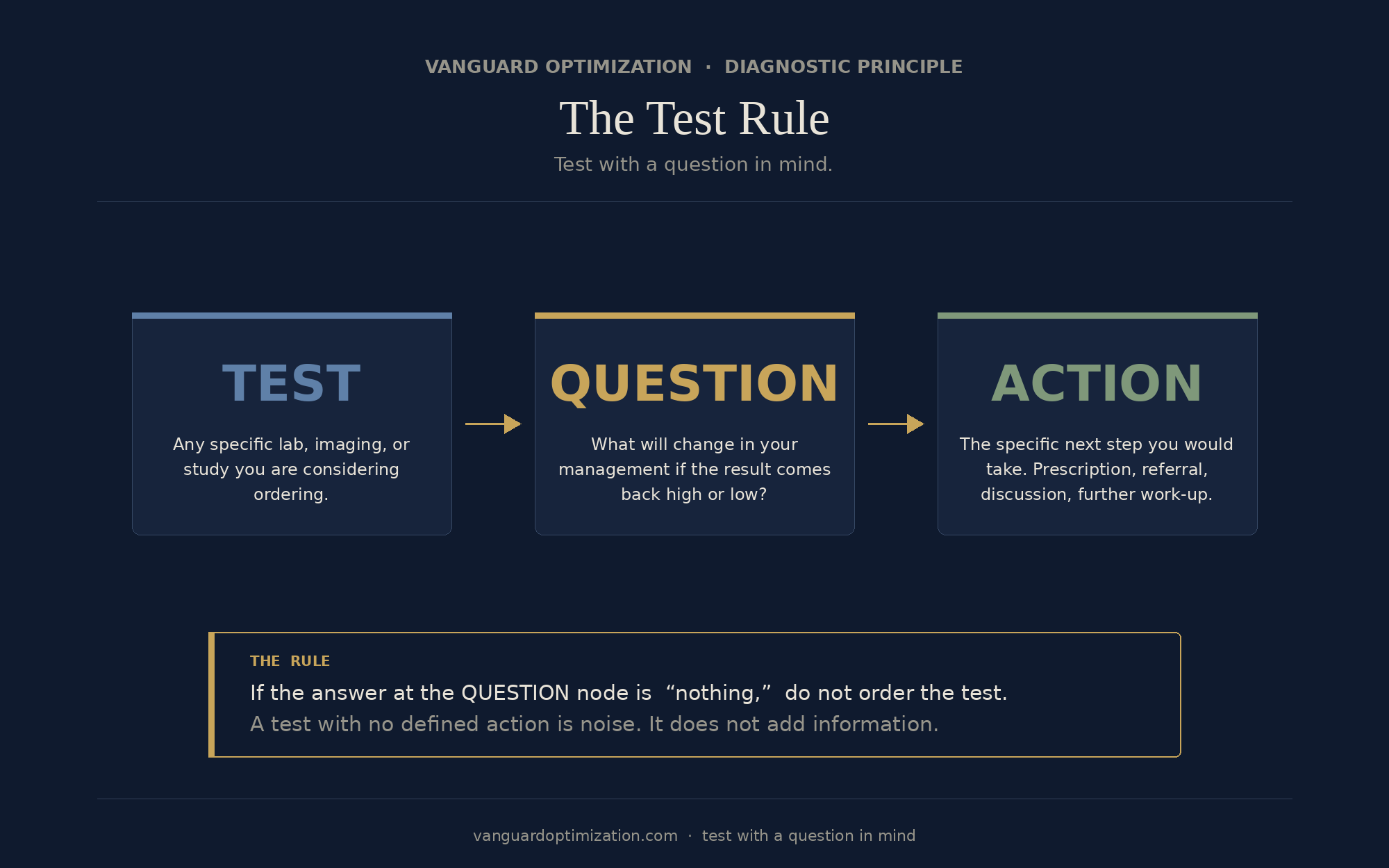
The rule that resolves this: test with a question in mind. Ordering a test you don’t know how to act on doesn’t add information. It adds noise.
Two lists in this monograph:
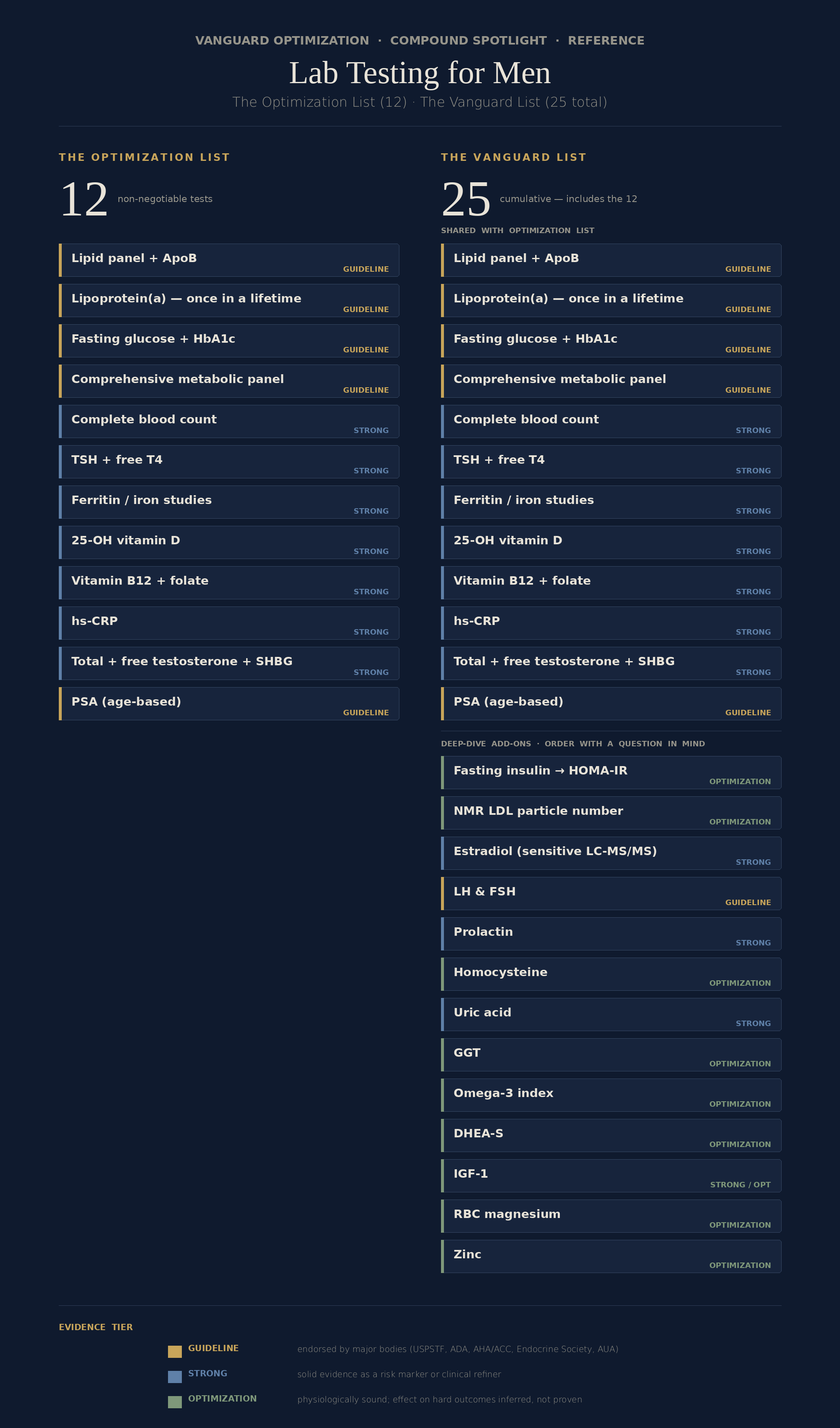
- The Optimization List — the non-negotiable minimum. Twelve tests. If you’re going to make hormone, cardiovascular, or metabolic decisions on yourself, these are the floor. Skip any of them and you are guessing.
- The Vanguard List — the full cumulative set of twenty-five tests that add meaningful information to a health, wellness, and longevity program. The Optimization List plus thirteen deep-dive add-ons for family history, borderline baselines, or aggressive optimization.
Both lists are tiered by evidence — GUIDELINE, STRONG, or OPTIMIZATION — so you can see, at a glance, which numbers to treat as settled and which are Vanguard’s read on a still-developing field.
Overview
When someone asks me what labs they should have before starting an optimization protocol, my answer isn’t a menu of tests. It’s a philosophy.
Testing exists to replace guessing with data. That’s the whole point. But “more tests” is not “more health.” An unindicated test with an unclear question behind it produces one of two outcomes — both bad. Either it comes back normal and you’ve spent money for nothing, or it comes back off, and now you’re chasing a number you shouldn’t have been looking at in the first place. The literature calls this the incidentaloma problem in imaging; the same principle applies to labs.
The two-panel structure below reflects how a careful physician actually thinks about this:
- The Optimization List is what a competent internist would consider the minimum evaluation before intervening on hormones, lipids, or metabolic health. It’s not “optimization” in the influencer sense — it’s the basic instrumentation. You do not get to skip these.
- The Vanguard List is the additional tests that add real information when you know what question you’re asking. Family history of premature heart disease? Add the particle number and the estradiol. Borderline testosterone with symptoms? Add LH, FSH, and prolactin to figure out where the axis broke. Suspected metabolic dysfunction with normal glucose and HbA1c? Add the fasting insulin. Aggressive longevity focus? Add homocysteine, uric acid, GGT, and the omega-3 index. Not everyone needs everything. Everyone should have thought about what they need.
Every test on both lists is tagged with an evidence tier so you can see the honesty of the recommendation.
Vanguard evidence rating (at a glance)
Three tiers apply to every test in this monograph. This is the Vanguard read of what the evidence actually supports — not a repackaging of any single guideline.
- GUIDELINE — endorsed for screening or risk assessment by at least one major body (USPSTF, ADA, AHA/ACC, Endocrine Society, AUA). Randomized-trial evidence supports the screen and the intervention. When a test carries this tier, the debate isn’t “should this be measured” — it’s how, when, and how often.
- STRONG — strong evidence as a risk marker or clinical refiner. Not a guideline universal screen, but observational and often trial evidence links the marker to hard outcomes. Guideline bodies routinely acknowledge it in intermediate-risk cases.
- OPTIMIZATION — physiologically sound and widely used in careful optimization practice. Not a guideline screening test; the effect on hard outcomes is inferred rather than proven. Real value when interpreted honestly; noise when treated as authoritative.
A guideline endorsement is randomized-trial-grade evidence for both the screen and the intervention. A STRONG test has observational or partial-trial evidence linking it to outcomes. An OPTIMIZATION test is mechanistically defensible but has not been shown in adequately powered trials to change outcomes when acted on.
The Optimization List
Twelve tests. Non-negotiable before starting any hormone, metabolic, or cardiovascular optimization work.
| Test | Tier | Standard reference range | Vanguard optimization target |
|---|---|---|---|
| Lipid panel + ApoB | GUIDELINE | Standard lab ranges for lipids; ApoB reference varies by risk stratum | ApoB < 90 mg/dL general; more aggressive in secondary prevention |
| Lipoprotein(a) — once in a lifetime | GUIDELINE | <30 mg/dL (<75 nmol/L) | Not a treatment target; a lifetime risk-amplifier |
| Fasting glucose + HbA1c | GUIDELINE | ADA thresholds (pre-diabetes/diabetes cut-offs, current publication) | Fasting glucose < 90 mg/dL; HbA1c < 5.4% |
| Comprehensive metabolic panel | GUIDELINE | Standard lab ranges | Same |
| Complete blood count | STRONG | Standard lab ranges | Same |
| TSH + free T4 | STRONG | Standard lab ranges (vary by lab) | TSH 0.5–2.5 mIU/L; free T4 upper-mid normal |
| Ferritin / iron studies | STRONG | Standard lab ranges (vary by lab); acute-phase reactant — see caveat below | 75–200 ng/mL common target — with the caveat that ferritin varies widely with inflammation, illness, and physiology |
| 25-OH vitamin D | STRONG | See vitamin D framing below | Correct documented deficiency; do not chase a level |
| Vitamin B12 + folate | STRONG | Standard lab ranges (vary by lab); methylmalonic acid as tie-breaker at the low-normal border | B12 > 500 pg/mL |
| hs-CRP | STRONG | <1.0 mg/L low, 1.0–3.0 avg, >3.0 high | Persistently ≥2 mg/L is a signal |
| Total + free testosterone + SHBG | STRONG | See testosterone section | See testosterone section |
| PSA (age-based) | GUIDELINE | Age- and risk-adjusted | Not a Vanguard-set target |
The reasoning, briefly.
- Lipid panel + ApoB. Both. Standard lipids give you HDL, triglycerides, and the calculated LDL. ApoB counts atherogenic particles directly — one per LDL, VLDL, IDL, and Lp(a) — which is the mechanistically correct atherogenic exposure. In discordance cases (typical of insulin resistance, metabolic syndrome, or high-triglyceride states), calculated LDL underestimates true atherogenic burden and ApoB catches what LDL misses. Vanguard’s general-population optimization target is ApoB <90 mg/dL. Cross-reference: ApoB vs LDL.
- Lipoprotein(a). Genetically determined; measure it once in adulthood and never again. A high result is a lifetime cardiovascular risk amplifier and a reason to intensify management of every other modifiable risk factor. Multiple 2023–2026 guideline updates now recommend measuring at least once in all adults. Cross-reference: Lipoprotein(a).
- Fasting glucose + HbA1c. Together. Glucose is the snapshot; HbA1c is the three-month average. Discordance between them points to conditions affecting either (hemoglobinopathies, iron deficiency, CKD). Vanguard’s optimization targets — <90 mg/dL and <5.4% — are more aggressive than ADA thresholds, reflecting the observational read on metabolic-risk trajectories at the low-normal end.
- CMP + CBC. Baseline organ function and hematologic status. Cheap, standard, rule out large numbers of confounders.
- TSH + free T4. Screen for hypo- and hyperthyroidism. If symptoms suggest thyroid disease with normal TSH, the deep-dive panel adds free T3, reverse T3, and antibodies. Cross-reference: The Comprehensive Thyroid Panel.
- Ferritin / iron studies. Under-recognized cause of fatigue in men. Low ferritin without overt anemia can produce meaningful fatigue. Important caveat: ferritin is an acute-phase reactant. It rises with inflammation, infection, obesity, liver disease, alcohol, malignancy, and metabolic syndrome. A “normal” ferritin in active inflammation can mask iron deficiency; a “high” ferritin isn’t automatically iron overload. Interpret with hs-CRP and iron studies (iron, TIBC, transferrin saturation).
- 25-OH vitamin D. The 2024 Endocrine Society guideline recommends the RDA for healthy adults under 75 without routine 25-OH screening. The BMJ 2026 meta-analysis by Massé et al. (36 trials, 92,045 participants) found high-certainty evidence of no fracture or fall benefit from vitamin D alone. Combined calcium + vitamin D showed statistically significant fracture reduction (RR 0.91, 95% CI 0.84–0.99) but below the authors’ clinical-meaningfulness threshold. Vanguard tests 25-OH vitamin D anyway — correct deficiency, do not chase a level.
- B12 + folate. Low B12 is a randomized-trial and observational cause of fatigue, cognitive symptoms, and macrocytic anemia. High-risk: vegetarians, older adults, chronic PPI users, long-term metformin users. Serum B12 imperfect at low-normal border; methylmalonic acid is the tie-breaker. Vanguard’s target >500 pg/mL reflects observational data on subtle symptoms at low-normal B12.
- hs-CRP. Cardiovascular risk refiner. JUPITER-era evidence (rosuvastatin vs placebo, hs-CRP ≥2 mg/L, LDL <130) showed hard-outcome benefit. Persistently ≥2 mg/L can move statin decisions in intermediate-risk men. Marker of inflammation, not a specific disease diagnosis.
- Testosterone (total + free + SHBG). See the dedicated section. Vanguard’s position — that we test testosterone even in asymptomatic men — departs from current Endocrine Society and AUA recommendations. Our rationale: “asymptomatic” is often “symptoms not yet attributed to hypogonadism.” A baseline reveals trajectory over time. We do not treat a number without symptoms.
- PSA (age-based). Shared-decision screening in men 55–69 (USPSTF), earlier baseline in African-American men and first-degree family history. Cross-reference: PSA Testing Strategy.
[DIAGRAM PROMPT: Two-panel visual — Optimization List (12) + Vanguard List (25 total). Tier color-coded: GUIDELINE gold, STRONG blue, OPTIMIZATION sage. Dark navy background, restrained palette, brand gold accent. Clinical-illustrative, NEJM/Nature editorial feel.]
The Vanguard List
The Optimization List plus thirteen additional tests that add meaningful information when there is a specific question behind them. Order the deep-dive tests with a question in mind, not as a fishing expedition.
| Test | Tier | When it adds information |
|---|---|---|
| Fasting insulin → HOMA-IR | OPTIMIZATION | Suspected metabolic dysfunction; family history of T2DM; normal glucose/HbA1c but clinical concern. Common target: insulin <5 µIU/mL; HOMA-IR <1.5. |
| NMR LDL particle number | OPTIMIZATION | ApoB/LDL discordance; borderline lipids with strong family history |
| Estradiol (sensitive LC-MS/MS) | STRONG | Testosterone therapy monitoring; unexplained gynecomastia; obesity |
| LH & FSH | GUIDELINE | Distinguishing primary vs secondary hypogonadism when testosterone is low |
| Prolactin | STRONG | Low testosterone with low or normal LH; libido/erectile issues without clear cause |
| Homocysteine | OPTIMIZATION | Family history of premature vascular disease; B12/folate context |
| Uric acid | STRONG | Hypertension, metabolic syndrome, gout risk, thiazide use, kidney stones |
| GGT | OPTIMIZATION | Occult liver injury or heavy alcohol; metabolic-syndrome refiner |
| Omega-3 index | OPTIMIZATION | Baselining before or during EPA/DHA supplementation; family history |
| DHEA-S | OPTIMIZATION | Adrenal reserve context; specific hormonal workups |
| IGF-1 | STRONG (diagnosis) / OPTIMIZATION (target) | Diagnostic in growth-hormone disorders; weak as an optimization target |
| RBC magnesium | OPTIMIZATION | Suspected chronic magnesium depletion, cramping, arrhythmias, refractory hypertension |
| Zinc | OPTIMIZATION | Low libido, poor wound healing, restrictive diet, chronic PPI/diuretic use |
Deep-dive reasoning highlights. Fasting insulin catches insulin resistance earlier than glucose/HbA1c; assay variability is real, cut-offs are Vanguard’s read. NMR particle number resolves ApoB/LDL discordance. Estradiol in men matters for bone, lipids, libido, mood — use the LC-MS/MS sensitive assay; cross-reference: Hormone Testing Methodology. LH/FSH tell you where the axis broke. Prolactin catches the pituitary adenoma. Homocysteine is an observational marker; B-vitamin supplementation trials to lower it have not reduced hard outcomes. Uric acid: hypertension, gout, thiazides, stones. GGT: hepatic stress marker; tracks with cardiovascular and mortality risk in observational data. Omega-3 index for baseline before supplementing. DHEA-S for adrenal reserve. IGF-1 diagnostic tier is real; optimization-target tier is not — the observational data is bidirectional (cancer signals higher, frailty lower). RBC magnesium is closer than serum. Zinc as practical measurement when clinical context suggests deficiency.
Getting testosterone right
More testosterone testing is done badly than any other lab in men’s health.
- Morning, fasting. Between 8–10 a.m. Testosterone follows a diurnal rhythm; afternoon draws are unreliable.
- Confirm before treating. ~30% of single low readings normalize on a second morning draw. A single value is a screen; two low values are a diagnosis.
- Total + free + SHBG, not total alone. Free testosterone (calculated Vermeulen from total+SHBG, or equilibrium dialysis; direct immunoassay inadequate at male concentrations) is the physiologically relevant fraction.
- LH and FSH for cause. Primary (testicular) vs secondary (pituitary/hypothalamic) hypogonadism.
- Method matters. LC-MS/MS from a CDC-certified lab. Cross-reference: Hormone Testing Methodology.
- Baseline PSA and hematocrit before therapy.
The threshold — Vanguard’s house position. The 2018 Endocrine Society guideline harmonized the lower limit at ~264 ng/dL. The AUA uses <300 ng/dL on two morning measurements plus symptoms. Vanguard’s house citation is the AUA threshold. Neither treats a number without symptoms. Both require two morning draws.
Beyond bloodwork
- Coronary Artery Calcium score. Non-contrast chest CT. A CAC of 0 is the strongest single negative predictor of near-term hard cardiovascular events. CAC >100 in a middle-aged man changes the statin conversation. Cross-reference: CAC monograph.
- DEXA scan. Bone density (under-diagnosed in men; higher post-fracture mortality) and body composition. Cross-reference: DEXA monograph.
- CGM in non-diabetic optimization. Useful for a defined period; marginal information plateaus after weeks. Not an ongoing biomarker for healthy adults. Cross-reference: CGM monograph.
What we don’t routinely recommend
- Multi-cancer blood screens (Galleri). Interesting technology; developing evidence. NHS-Galleri trial missed primary endpoint at ASCO 2026. No mortality benefit demonstrated. Cross-reference: Galleri monograph.
- Full-body MRI (Prenuvo, Ezra, Q Bio). Incidentaloma problem is real; ~95% abnormal findings, ~91% not clinically relevant, zero RCT mortality evidence. Cross-reference: Full-Body MRI monograph.
- Epigenetic age clocks. Mechanistically interesting, biologically real signals; connection to hard outcomes not established. Cross-reference: Epigenetic Age Clocks monograph.
Where Vanguard differs from current guidelines. Two departures worth naming openly, because credibility means saying when we don’t follow the majority position.
- Vitamin D screening — we do test. The 2024 Endocrine Society guideline recommends against routine 25-OH screening. Vanguard tests it anyway. Rule: correct documented deficiency, do not chase a level, do not megadose. The BMJ 2026 Massé meta-analysis is the honest reason not to over-treat. But knowing whether a patient is deficient still shapes the sun-exposure, diet, and modest-supplementation conversation.
- Testosterone screening in asymptomatic men — we do test. Endocrine Society and AUA both explicitly recommend against. Vanguard tests it anyway, because “asymptomatic” is often “symptoms not yet attributed to hypogonadism.” Baseline reveals trajectory. We do not treat a number without symptoms.
For You
Education, not prescription. What a member could reasonably bring to their own physician.
- Ask for the Optimization List first. If your last workup didn’t include ApoB, Lp(a), and the full testosterone triad, you don’t have a real baseline.
- Draw testosterone 8–10 a.m., fasting. If low, ask for a second morning draw before treatment conversation.
- Get Lp(a) once. Then never again. Genetically fixed. High number means intensify everything else.
- Ask what the question is before adding a test. A test with no defined action is noise.
- Don’t chase a vitamin D number. Correct documented deficiency. Don’t megadose prophylactically.
- Interpret ferritin in context. A single ferritin number without hs-CRP and other iron studies can badly mislead.
Uncertainty and open questions
- Optimization ranges. Vanguard’s targets (ApoB <90, glucose <90, HbA1c <5.4%, TSH 0.5–2.5, ferritin 75–200, B12 >500, fasting insulin <5, HOMA-IR <1.5) are our read of a still-developing literature. Not guideline ranges. A patient at the “normal” end of guideline and “not-yet-optimal” end of Vanguard does not have a disease. They have a discussion to have.
- Fasting insulin cut-offs. Assay variability real; whether persistently elevated fasting insulin in a metabolically healthy adult predicts hard outcomes beyond glucose/HbA1c is not settled by RCTs — the reason it’s on the Vanguard List, not the Optimization List.
- Testosterone thresholds. 264 vs 300 ng/dL guideline disagreement is live. No adequately-powered trial in the 265–299 gap.
- Our departure on vitamin D and testosterone screening. We know the guideline majority recommends against both. We test both anyway. Reasonable people disagree; we state our position openly.
- Non-diabetic CGM. Useful for a defined observation period; the claim that it improves hard outcomes in healthy adults has not been demonstrated in adequately-powered trials.
- IGF-1 as an optimization target. Bidirectional observational associations. No established healthy-adult IGF-1 target that improves hard outcomes.
References
- USPSTF — lipid disorders, diabetes, prostate cancer screening recommendations (current publication).
- 2018 AHA/ACC Guideline on the Management of Blood Cholesterol (Grundy et al., Circulation 2019;139:e1082–e1143).
- 2026 ACC/AHA Guideline on the Management of Dyslipidemia — retires and replaces the 2018 blood-cholesterol guideline; endorses selective ApoB measurement in ASCVD, CKM syndrome, T2DM, and elevated triglycerides; ApoB can be more accurate than LDL-C in these settings. PubMed ID 41824590.
- ESC / EAS — Lp(a) once-in-lifetime measurement recommendation (2023–2026 updates).
- 2018 Endocrine Society Testosterone Guideline (Bhasin et al., JCEM 2018;103:1715–1744) — 264 ng/dL harmonized lower limit; two morning measurements; recommends against screening asymptomatic men. Also documents ~30% of single low readings normalize on repeat.
- AUA Testosterone Deficiency Guideline (2018, amended) — <300 ng/dL threshold on two morning measurements plus symptoms. Vanguard’s house citation on testosterone threshold.
- 2024 Endocrine Society Vitamin D Guideline (Demay et al., JCEM 2024). Vanguard departs from the “against routine screening” position.
- Massé O, Marques-Vidal P, Durand M, et al. Calcium, vitamin D, or combined supplementation to prevent fractures and falls: systematic review and meta-analysis. BMJ 2026;393:bmj-2025-088050. DOI: 10.1136/bmj-2025-088050. Vitamin D alone: 36 trials, 92,045 participants; high-certainty no benefit. Combined calcium+D: RR 0.91 for fractures, below authors’ clinical-meaningfulness threshold.
- JUPITER trial (Ridker et al., NEJM 2008;359:2195–2207) — hs-CRP-informed statin decisions.
- Vermeulen equation (Vermeulen et al., JCEM 1999;84:3666–3672).
- ADA Standards of Medical Care in Diabetes (current publication).
- CDC Hormone Standardization Program (HoSt) — testosterone LC-MS/MS certification.
Disclaimer
This monograph is physician-led educational content. It is not medical advice, and it does not diagnose, treat, or establish a doctor–patient relationship. Every test discussed carries interpretation nuance that depends on your specific clinical situation. Talk with your own physician before adding tests to your workup, changing your management, or acting on any specific result.