Overview
Bacopa monnieri (often labeled Brahmi) is a water-loving herb used for centuries in Ayurvedic practice for memory and learning. In the men’s-health and “nootropic” aisle it is sold as an instant focus pill, an intelligence booster, an Alzheimer alternative, and sometimes a stimulant-free option for attention-deficit hyperactivity disorder (ADHD).
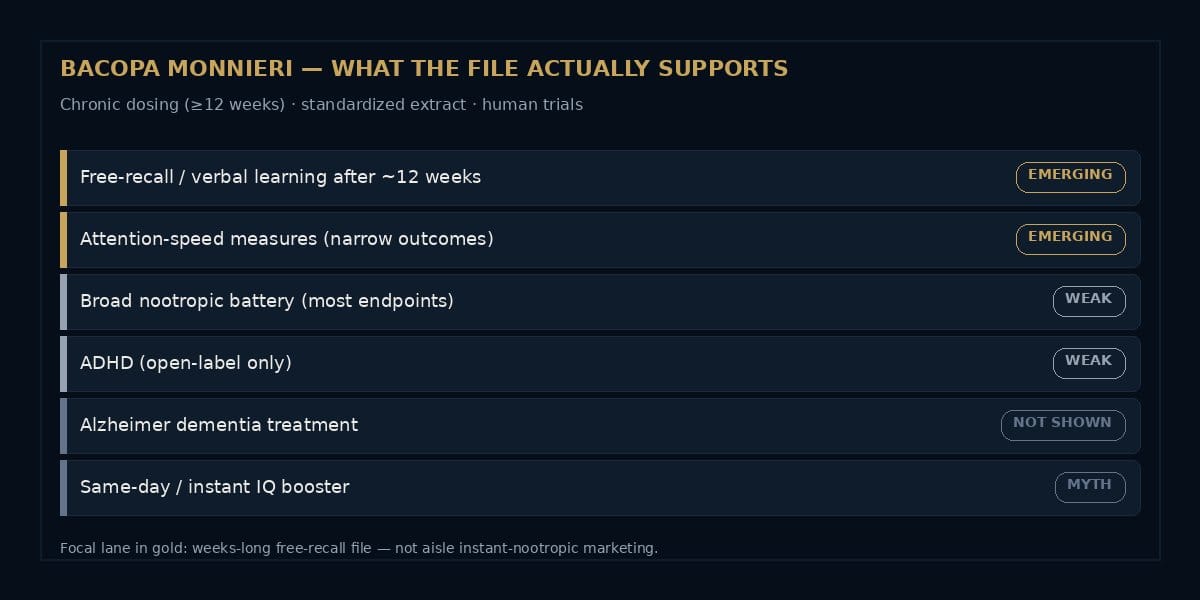
Those marketing lanes are not the same object as the clinical file. The densest randomized human evidence is about chronic use of a standardized extract — commonly about 300 mg per day for twelve weeks or longer — with the most consistent positive findings on free-recall / verbal learning tasks such as the Rey Auditory Verbal Learning Test (AVLT). Attention-speed outcomes appear in some meta-analyses but are narrow. Alzheimer dementia treatment evidence is very low certainty with no clear benefit. Same-day IQ claims rest on designs the positive trials did not use. ADHD claims rest largely on open-label work.
This monograph grades the chronic free-recall lane separately from the aisle story.
Evidence
Free-recall / verbal learning after chronic dosing (strongest human lane)
Pase et al., 2012 (Journal of Alternative and Complementary Medicine; PMID 22747190). Systematic review of six randomized, controlled trials in adults without dementia. All trials ran twelve weeks; extracts 300–450 mg/day. Across studies, Bacopa improved performance on 9 of 17 free-recall memory tests. Little evidence of enhancement in other cognitive domains. Authors: preliminary evidence for free recall; research still early.
Morgan & Stevens, 2010 (Journal of Alternative and Complementary Medicine; PMID 20590480). Randomized, double-blind, placebo-controlled trial; BacoMind 300 mg/day ×12 weeks; adults over 55; 98 started, 81 completed. AVLT verbal learning and delayed recall improved versus placebo (trial a7 delayed recall p=0.001; total learning p=0.011). Gastrointestinal adverse effects versus placebo included increased stool frequency, nausea, and abdominal cramps.
Calabrese et al., 2008 (Journal of Alternative and Complementary Medicine; PMID 18611150). Randomized, double-blind, placebo-controlled; 300 mg/day ×12 weeks; age ≥65; 54 randomized, 48 completers (24 per arm). Enhanced AVLT delayed word recall and Stroop performance versus placebo. Adverse events mainly stomach upset (Bacopa 9 / placebo 10).
Stough et al., 2001 (Psychopharmacology; PMID 11498727). KeenMind 300 mg/day; testing at 5 and 12 weeks. Improved inspection time, AVLT learning/consolidation, and state anxiety versus placebo, with maximal effects at 12 weeks — not an acute same-day design.
Stough et al., 2008 (Phytotherapy Research; PMID 18683852). KeenMind 2×150 mg ×90 days; 107 enrolled, 62 completers with high compliance. Improved Working Memory factor (spatial working memory accuracy); fewer false positives on rapid visual information processing.
Grade for chronic free-recall / verbal learning at ~300 mg/day for ~12 weeks in healthy or older adults: EMERGING — replicated across several randomized trials and a systematic review, but samples are modest, extracts differ, and the effect is domain-specific rather than a global intelligence upgrade.
Attention speed — positive on narrow pools, not a broad battery
Kongkeaw et al., 2014 (Journal of Ethnopharmacology; PMID 24252493). Meta-analysis of nine randomized controlled trials of chronic (≥12 weeks) standardized Bacopa without co-medications; 518 enrolled / 437 analyzed. Trail Making B time shortened by −17.9 ms (95% CI −24.6 to −11.2; p<0.001) — that pool rests on a single contributing study (Stough 2001) in the authors’ table. Choice reaction time was not improved when all doses were pooled (−30 ms; 95% CI −80 to 20; p=0.24). In a 300 mg/day subgroup (two Stough trials), choice reaction time shortened by −10.6 ms (95% CI −12.1 to −9.2; p<0.001). Authors called for head-to-head trials against existing medicines.
Grade for attention-speed claims: EMERGING / narrow — do not generalize a subgroup millisecond shift into “instant focus.”
Broader nootropic battery — mostly null in a later meta-analysis
Brimson et al., 2021 (Scientific Reports; PMID 33436817; PMC7803732). Eleven double-blind randomized controlled trials; 645 completers (323 Bacopa / 345 placebo). Most memory and attention outcomes showed no difference versus placebo. The only statistically significant outcome among the analyzed set was logical memory: standardized mean difference 1.11 (95% CI 0.43–1.80; p=0.001; I²≈73%), with publication-bias risk (Fail-Safe N≈49 in the narrative; table Fail-Safe N 43). AVLT proactive interference standardized mean difference 0.62 (95% CI −0.05 to 1.29; p=0.071) — not significant. Authors: limited clinical establishment overall.
Grade for “works across the cognitive battery”: WEAK.
Alzheimer dementia treatment — very low certainty, no clear benefit
Basheer et al., 2022 (Interactive Journal of Medical Research; PMID 35612544; PMC9379783). Systematic review of Bacopa for dementia due to Alzheimer disease / mild cognitive impairment. Five eligible studies (two Bacopa-only; three combinations); all judged high risk of bias; overall evidence quality very low. No difference versus placebo or donepezil on Mini-Mental State Examination / Alzheimer Disease Assessment Scale–Cognitive / Wechsler Memory Scale–class outcomes based on that certainty rating. No major safety issues flagged in the synthesis, but efficacy was not established.
Grade for Alzheimer treatment claims: not shown / MYTH relative to aisle substitution claims.
ADHD — open-label, not confirmatory efficacy
Dave et al., 2014 (Advances in Mind-Body Medicine; PMID 24682000). Open-label BacoMind 225 mg/day ×6 months in 31 children with ADHD; parent-rated symptom drops. No placebo control. Not confirmatory efficacy evidence.
Grade for “proven ADHD therapy”: WEAK.
Acute / same-day nootropic claims
Positive Bacopa cognition trials are overwhelmingly chronic. An acute Bacopa challenge in healthy adults (Nathan et al., related acute literature; Stough-line acute work) did not show same-session cognitive gains of the kind aisle “smart drug” marketing implies. Stough 2001’s benefits were maximal at 12 weeks. Instant IQ is aisle fiction relative to the chronic free-recall file.
Grade: MYTH for same-day IQ / instant nootropic.
Current-research pass (approximately last 18 months)
Recent randomized and review work has not upgraded Bacopa to a broad dementia or stimulant-class product:
• Kean-adjacent / mild cognitive impairment trial, 2024 (PMID 38538390): triple-blind randomized trial, 62 people with mild cognitive impairment, 160 mg/day ×8 weeks. Overall cognitive performance and sleep quality did not clearly separate on primary framing; some attention and verbal-fluency parameters differed at later time points. Does not establish Alzheimer treatment.
• Bacumen extract RCT, 2025 (PMID 41091332): 101 adults aged 40–70 with self-reported memory/attention problems; 300 mg/day ×12 weeks; 87 completers. No between-group differences on primary verbal learning (p=0.391), attention (p=0.713), or working memory (p=0.610). Secondary stress/fatigue self-reports favored Bacopa; digestive complaints and headaches were more frequent with active extract.
• Narrative and network-meta reviews in 2025–2026 continue to discuss mechanistic and cognitive literature; they do not replace the Alzheimer systematic review’s very-low-certainty “no difference” conclusion or turn Bacopa into an instant nootropic.
The EMERGING grade for the chronic free-recall lane still fits; the WEAK/MYTH grades for broad battery, Alzheimer treatment, ADHD confirmation, and same-day IQ still fit.
Clinical relevance
Mechanism (labelled as mechanism). Bacopa saponins (bacosides) are discussed in preclinical literature for antioxidant effects, cholinergic modulation, and synaptic plasticity pathways. Those mechanisms are plausible research stories. They are not themselves clinical outcomes for retail capsules.
Safety and who should not. Gastrointestinal upset is the common theme in trials (Morgan 2010: stool frequency, cramps, nausea; Calabrese: stomach upset). Bacumen 2025 also noted more digestive complaints and headaches versus placebo. Bacopa is sold in the United States as a dietary supplement — not Food and Drug Administration (FDA)–approved to treat dementia, ADHD, anxiety, or memory disorders. People who are pregnant, breastfeeding, or on multiple prescription medicines should involve their own clinician before adding any herbal extract. Do not stop Alzheimer, ADHD, or psychiatric medicines based on supplement marketing.
Interactions and monitoring. Formal drug–interaction maps for Bacopa are thinner than for many prescription agents. Clinicians may weigh concurrent sedatives, cholinergic/anticholinergic regimens, thyroid disease workups, and gastrointestinal vulnerability. There is no consumer lab panel that converts a Bacopa bottle into a dementia drug.
Literature dose ranges (education only — not a personal prescription). Many positive free-recall trials used about 300 mg/day of a standardized extract for ≥12 weeks (some protocols 300–450 mg/day). ADHD open-label work used 225 mg/day for six months — still not confirmatory. Acute single-dose designs are not the positive chronic file.
For you (practical)
This section is education for conversations with your own physician — not a recommendation to start, stop, or dose anything.
Questions to bring to one’s own physician:
• If the interest is everyday verbal memory/learning in a healthy or older adult — ask whether a twelve-week, standardized-extract discussion matches the free-recall trial lane (Pase/Morgan/Calabrese/Stough), and whether gastrointestinal side effects are acceptable.
• If the interest is Alzheimer disease or “replacing donepezil” — carry Basheer 2022’s very-low-certainty no difference finding; specialist neurology/geriatrics remains the frame.
• If the interest is ADHD — open-label parent ratings are not a placebo-controlled efficacy file; stimulant and guideline-directed care are not replaced by Bacopa marketing.
• If the interest is same-day focus, exam-day IQ, or a broad smart-drug stack — the positive human Bacopa file is chronic and domain-specific; Brimson 2021 found most battery endpoints null; Bacumen 2025 was null on its cognition primaries.
Who might discuss it with a clinician: adults curious about a time-limited trial of a standardized extract for free-recall goals, with eyes open to stomach side effects and to the limits of the evidence. Who probably would not find the aisle story useful: anyone expecting an instant nootropic, Alzheimer monotherapy, or proven ADHD replacement.
Talk with your physician before making changes.
Uncertainty and open questions
• Which Bacopa extract and bacoside standardization truly replicate across labs remains unsettled; KeenMind, BacoMind, Bacumen, and other products are not interchangeable by label alone.
• How far free-recall gains extend beyond twelve weeks — and beyond five years — is not characterized in the sources used here.
• Whether attention-speed millisecond changes (including single-study Trail B pooling and 300 mg CRT subgroups) matter in daily life is unclear.
• Whether recent null cognition primaries (Bacumen 2025) reflect extract differences, population differences (self-reported complaints), or a genuine attenuation of earlier effects needs larger head-to-head work.
• Alzheimer and mild cognitive impairment treatment claims remain very low certainty; combination-herb cocktails muddle attribution.
• ADHD confirmatory randomized controlled trials with adequate blinding and clinically meaningful endpoints are still needed.
• Industry funding and publication bias risk (flagged in Brimson for logical memory) deserve continued attention.
Verdict
EMERGING — Bacopa has a real, domain-specific human file for free-recall / verbal learning after about twelve weeks of standardized extract in healthy or older adults; it is not an instant nootropic, not established Alzheimer therapy, and not proven ADHD medicine.
References
1. Pase MP, et al. The cognitive-enhancing effects of Bacopa monnieri: a systematic review of randomized, controlled human clinical trials. J Altern Complement Med. 2012;18(7):647-652. PMID: 22747190.
2. Morgan A, Stevens J. Does Bacopa monnieri improve memory performance in older persons? Results of a randomized, placebo-controlled, double-blind trial. J Altern Complement Med. 2010;16(7):753-759. PMID: 20590480.
3. Calabrese C, et al. Effects of a standardized Bacopa monnieri extract on cognitive performance, anxiety, and depression in the elderly: a randomized, double-blind, placebo-controlled trial. J Altern Complement Med. 2008;14(6):707-713. PMID: 18611150.
4. Stough C, et al. The chronic effects of an extract of Bacopa monniera (Brahmi) on cognitive function in healthy human subjects. Psychopharmacology (Berl). 2001;156(4):481-484. PMID: 11498727.
5. Stough C, et al. Examining the nootropic effects of a special extract of Bacopa monniera on human cognitive functioning: 90 day double-blind placebo-controlled randomized trial. Phytother Res. 2008;22(12):1629-1634. PMID: 18683852.
6. Kongkeaw C, et al. Meta-analysis of randomized controlled trials on cognitive effects of Bacopa monnieri extract. J Ethnopharmacol. 2014;151(1):528-535. PMID: 24252493.
7. Brimson JM, et al. The effectiveness of Bacopa monnieri (Linn.) Wettst. as a nootropic, neuroprotective, or antidepressant supplement: analysis of the available clinical data. Sci Rep. 2021;11(1):596. PMID: 33436817.
8. Basheer A, et al. Use of Bacopa monnieri in the Treatment of Dementia Due to Alzheimer Disease: Systematic Review of Randomized Controlled Trials. Interact J Med Res. 2022;11(2):e38542. PMID: 35612544.
9. Dave UP, et al. An open-label study to elucidate the effects of standardized Bacopa monnieri extract in the management of symptoms of attention-deficit hyperactivity disorder in children. Adv Mind Body Med. 2014;28(2):10-15. PMID: 24682000.
10. Kean JD, et al. Evaluating the effects of Bacopa monnieri on cognitive performance and sleep quality of patients with mild cognitive impairment: A triple-blinded, randomized, placebo-controlled trial. Explore (NY). 2024. PMID: 38538390.
11. Lopresti AL, et al. The Effects of a Bacopa monnieri Extract (Bacumen) on Cognition, Stress, and Fatigue in Healthy Adults: A Randomized, Double-Blind, Placebo-Controlled Trial. Clin Drug Investig. 2025. PMID: 41091332.
Disclaimer
Vanguard Optimization provides physician-led, evidence-based education only. This monograph is not medical advice, does not diagnose or treat, and does not establish a physician–patient relationship. Compounds discussed may carry risks and interactions specific to your health. Talk with your own physician before making changes.