Overview
Vitamin B12 (cobalamin) is a water-soluble vitamin needed for red-blood-cell production, DNA synthesis, and the myelin that coats nerves. The body does not make it. Animal foods supply it; plant foods do not. Absorbing the usual diet-sized amount depends on stomach acid to free protein-bound B12 and on intrinsic factor, a protein made in the stomach that carries B12 into the small bowel. A small fraction of a very large oral dose can still cross by simple diffusion, which is why high-dose pills can work even when the usual path is broken.
On the supplement shelf, B12 is sold for energy, memory, nerve health, and heart protection. In medicine it is a treatment for a measured deficiency — pernicious anemia, stomach or bowel surgery, long-term metformin, acid-suppressing drugs, vegan diets, and older age that blunts absorption. Those two uses are not the same question.
This review asks: When levels are low, does correcting them work, and can pills match injections? When levels are already adequate or only moderately low without anemia, do pills help fatigue, cognition, nerves, or the heart? What should people on metformin or acid blockers ask their physician? The answers split cleanly: deficiency correction is established; the consumer claims in replete people failed randomized trials.
In the United States, oral cyanocobalamin, methylcobalamin, and related forms are dietary supplements when sold over the counter. Injectable cyanocobalamin is a prescription drug with an FDA label for deficiency from malabsorption. Neither setting licenses B12 as a general energy or memory product.
Evidence
Graded strongest first: randomized controlled trials and systematic reviews, then observational cohorts, then mechanism and labels, then marketing claims.
Randomized controlled trials: correcting a true deficiency (oral versus injection)
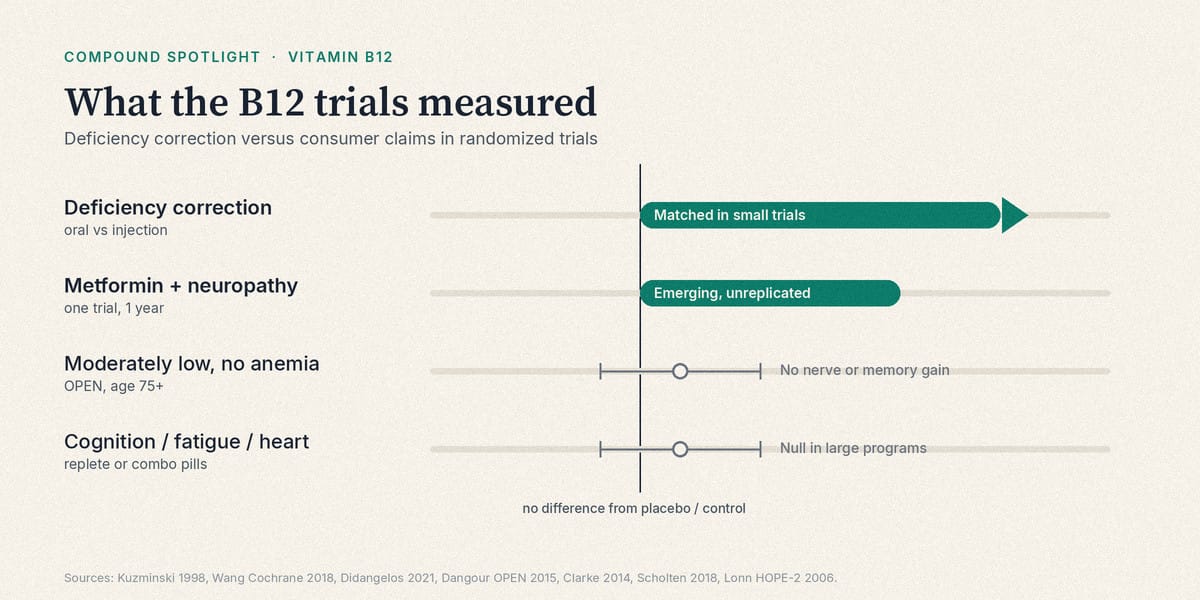
Kuzminski and colleagues, 1998 (Blood; PMID 9694707). Newly diagnosed cobalamin-deficient adults were randomized to cyanocobalamin 2 mg by mouth every day for 120 days or 1 mg intramuscularly on days 1, 3, 7, 10, 14, 21, 30, 60, and 90. Thirty-eight people were randomized; five were later found to have folate deficiency, leaving 18 evaluable in the oral group and 15 in the injection group. Correction of blood counts and neurologic findings was prompt and indistinguishable between groups. Mean serum B12 at four months was 1,005 pg/mL on oral therapy versus 325 pg/mL on injections (P < .0005); methylmalonic acid also favored the oral arm. This is a small trial, but it is the clearest head-to-head demonstration that high-dose oral therapy can match the standard injection schedule for deficiency correction.
Wang and colleagues, 2018 (Cochrane systematic review; PMID 29543316; DOI 10.1002/14651858.CD004655.pub3). Three randomized controlled trials, 153 participants (74 oral, 79 intramuscular), treated for three to four months. The review found similar normalization of serum B12 and rated the evidence low quality because of few trials and participants. One trial that used 2,000 µg a day by mouth showed a mean difference of 680 pg/mL favoring oral therapy. The authors concluded that oral and intramuscular routes look similar for raising blood levels, with lower treatment-associated costs for oral therapy in one trial, and called for better-reported larger trials that measure clinical symptoms.
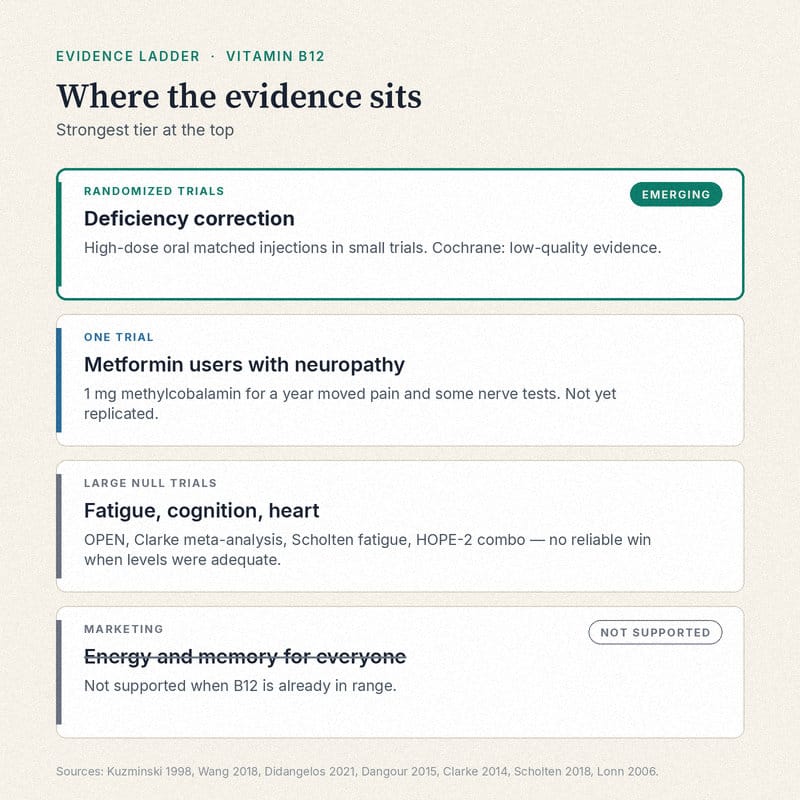
How to read this tier. Correcting a documented deficiency is established clinical practice and an FDA-labeled use for parenteral cyanocobalamin. High-dose oral therapy matched injections in these small trials; the certainty is low, and the injection label still calls oral therapy "not dependable" in pernicious anemia. The practical takeaway for education is that oral high-dose options exist and have trial support, not that every person with pernicious anemia should abandon lifelong parenteral care without a clinician's plan.
Randomized controlled trial: metformin users with diabetic neuropathy
Didangelos and colleagues, 2021 (Nutrients; PMID 33513879). Ninety adults with type 2 diabetes on metformin for at least four years, both peripheral and autonomic diabetic neuropathy, and serum B12 below 400 pmol/L were randomized to oral methylcobalamin 1,000 µg a day (n = 44) or placebo (n = 46) for one year. In the active group, vibration perception threshold, neuropathy questionnaire scores, quality-of-life score, pain score, sural nerve conduction velocity, sural nerve action potential, and foot sudomotor conductance moved in a favorable direction within the group. Several of those same indices worsened within the placebo group. A between-group analysis adjusted for blood sugar control found significant differences for pain score and foot sudomotor conductance; the change in several other nerve indices did not differ significantly between groups. The pharmaceutical company that supplied the tablet had, per the authors, no role in design or analysis. This is a single positive trial in a specific population (metformin users with neuropathy and low-normal to low B12 by the trial's threshold). It sits in the EMERGING lane: promising, not yet replicated, and partly dependent on within-group contrasts.
Randomized controlled trials that found no benefit in replete or mildly low people
OPEN trial — Dangour and colleagues, 2015 (American Journal of Clinical Nutrition; PMID 26135351). Two hundred one adults aged 75 and older with moderately low serum B12 (107–210 pmol/L), no anemia, and no neurologic or cognitive signs attributed to deficiency received 1 mg oral B12 or placebo daily for 12 months; 191 provided outcomes. Serum B12 and holotranscobalamin rose sharply on active treatment. The primary outcome — posterior tibial compound muscle action potential amplitude — showed no difference (mean difference −0.2 mV; 95% confidence interval −0.8 to 0.3). Secondary nerve, cognitive, and clinical exam outcomes were likewise unchanged. Moderately low numbers without anemia or symptoms did not translate into a measurable gain from a year of high-dose pills.
Clarke and colleagues, 2014 (American Journal of Clinical Nutrition; PMID 24965307). Meta-analysis of 11 trials with cognitive data on about 22,000 people. B-vitamin regimens (often folic acid with B6 and B12) lowered homocysteine by about 26–28%. Global cognition z-score differences versus placebo were 0.00 (−0.05 to 0.06) in domain trials and −0.01 (−0.03 to 0.02) in Mini-Mental-type trials. Homocysteine went down; cognitive aging did not slow in a detectable way. These were B-vitamin combinations, not B12 alone.
Scholten and colleagues, 2018 (Clinical Nutrition ESPEN; PMID 29460813). Ninety-five outpatients with irritable bowel syndrome or inflammatory bowel disease, disabling fatigue, and B12 at or above 150 pmol/L took 1,000 µg a day or placebo for eight weeks. Change in subjective fatigue was −8.1 versus −8.3 (not significant). A motivation subscale showed a small difference; depression and quality-of-life scores did not. Surplus B12 for fatigue with adequate blood levels did not work in this trial.
HOPE-2 — Lonn and colleagues, 2006 (New England Journal of Medicine; PMID 16531613). Five thousand five hundred twenty-two patients aged 55 and older with vascular disease or diabetes received folic acid 2.5 mg plus vitamin B6 50 mg plus vitamin B12 1 mg, or placebo, for about five years. The primary composite of cardiovascular death, myocardial infarction, and stroke occurred in 18.8% versus 19.8% (relative risk 0.95; 95% confidence interval 0.84–1.07). Cardiovascular death and myocardial infarction were not reduced. Stroke was lower as a secondary finding (relative risk 0.75). This was a B-vitamin combination, not B12 alone, and it does not support marketing B12 as heart protection.
Observational studies and safety findings
Aroda and colleagues, 2016 (Diabetes Prevention Program / Outcomes Study; PMID 26900641). Secondary analysis: low B12 (≤203 pg/mL) was more common with metformin than placebo at five years (4.3% versus 2.3%; P = .02) but not significantly at thirteen years (7.4% versus 5.4%; P = .12). Combined low and borderline-low levels (≤298 pg/mL) were more common with metformin at both time points. Each year of metformin use was associated with higher odds of deficiency (odds ratio 1.13; 95% confidence interval 1.06–1.20). Neuropathy was more common among metformin users who had low B12. Association, not proof that every metformin prescription causes clinical deficiency — but enough to support lab checks.
Lam and colleagues, 2013 (JAMA; PMID 24327038). Case-control study in Kaiser Permanente Northern California: 25,956 people with incident B12 deficiency versus 184,199 without. Two or more years of proton-pump inhibitor (acid-blocking) use was associated with deficiency (odds ratio 1.65; 95% confidence interval 1.58–1.73); two or more years of histamine-2 blocker use had odds ratio 1.25 (1.17–1.34). Association consistent with acid-dependent absorption physiology.
Brasky and colleagues, 2017 (VITAL cohort; PMID 28829668). Among 77,118 adults, men whose 10-year average supplemental B12 intake from individual supplements exceeded 55 µg a day had a lung-cancer hazard ratio of 1.98 (95% confidence interval 1.32–2.97) versus nonusers. The association was not seen in women and was not seen for multivitamin sources in the same way. Observational only — not proof of harm, and not a reason to withhold deficiency treatment. It is a reason not to treat high-dose B12 as risk-free wellness.
DIVINe — House and colleagues, 2010 (JAMA; PMID 20424250). Two hundred thirty-eight people with diabetic nephropathy received folic acid 2.5 mg plus B6 25 mg plus B12 1 mg, or placebo. At 36 months, glomerular filtration rate had fallen more on B vitamins (−16.5 versus −10.7 mL/min/1.73 m²; mean difference −5.8; P = .02). A composite of myocardial infarction, stroke, revascularization, and death was more common on B vitamins (hazard ratio 2.0; 95% confidence interval 1.0–4.0; P = .04). Again a combination pill in kidney disease — a caution against assuming "more B vitamins" is always safer.
Labels and mechanism
The metformin prescribing information states that in 29-week trials about 7% of patients with previously normal serum B12 fell to subnormal levels, and it advises measuring hematologic parameters yearly and vitamin B12 at 2- to 3-year intervals.
The cyanocobalamin injection label lists malabsorption indications (including pernicious anemia and gastrointestinal surgery), notes that B12 is absent from plant foods and that deficiencies with normal absorption have been reported mainly in strict vegetarians, warns that folic acid doses above 0.1 mg a day may correct the anemia of B12 deficiency while neurologic damage progresses, and states that deficiency allowed to progress longer than three months may produce permanent spinal-cord lesions. Intravenous use loses almost all of the dose in the urine. The label still describes oral therapy as not dependable in pernicious anemia — tension with the small oral-versus-injection trials above that should be resolved with a clinician, not with a supplement aisle claim.
Marketing and influencer claims
"B12 for energy," "B12 for memory," and "B12 for heart health" in people with normal levels sit here. The fatigue trial, the cognition meta-analysis, and HOPE-2 do not support them. Claiming oral therapy never works for pernicious anemia is too absolute given Kuzminski and Cochrane, but abandoning injections without a plan is also unsupported.
Current-research pass (about April 2025 to October 2026)
A PubMed search on 2026-10-19 for title-focused B12 or cobalamin randomized trials, meta-analyses, and systematic reviews from April 2025 through October 2026 found comparative route reviews and replacement-strategy consensus pieces. Nothing overturned the split used here: deficiency correction stays the established lane; fatigue, cognition, and heart claims in replete people stay unsupported by the major null trials already cited. No retraction of the key trials in this review was identified for this build.
Clinical relevance
Mechanism (labelled as mechanism). B12 is a cofactor for methionine synthase and methylmalonyl-CoA mutase. Shortage raises homocysteine and methylmalonic acid and eventually impairs DNA synthesis in marrow and myelin maintenance in nerves. That pathway explains why correcting a true shortage works. It does not imply that extra B12 helps when the pathway is already supplied.
Who tends to run low. Pernicious anemia (intrinsic-factor failure), stomach or bowel surgery including gastrectomy, strict vegan diets without fortified foods or supplements, long-term metformin, long-term acid suppression, and older age with reduced acid or intrinsic factor. Pregnancy and lactation raise requirements.
Monitoring. For people on metformin, the FDA label's 2- to 3-year B12 check is a concrete anchor. Clinicians may also use methylmalonic acid when the serum B12 is borderline. Annual blood counts catch megaloblastic anemia but can miss neurologic disease if folic acid is masking the picture.
Interactions and cautions. Folic acid can clear the anemia of B12 deficiency while nerve damage continues — do not treat unexplained anemia with folic acid alone. High-dose B-vitamin combinations worsened kidney decline and vascular events in DIVINe. Observational data link high supplemental B12 in men with higher lung-cancer rates — association only. Leber's hereditary optic neuropathy is a labeled concern for cyanocobalamin injections. Parenteral B12 can rarely cause anaphylaxis. Intravenous administration is the wrong route for the injection product.
Who should not self-experiment. Anyone with unexplained neurologic symptoms, unexplained anemia, or a history of gastric surgery needs evaluation, not a shopping-cart protocol. People with diabetic kidney disease should not assume that high-dose B-vitamin "homocysteine formulas" are safe.
Literature dose ranges (study and label context only — not a personal regimen). Deficiency oral trials used about 1,000–2,000 µg cyanocobalamin daily for months; Didangelos used 1,000 µg methylcobalamin daily for a year; OPEN used 1 mg daily for a year (null). Injection labels use loading intramuscular doses then monthly maintenance. Usual dietary needs with normal absorption are microgram-scale.
For you
Bring these questions to your own physician — this is education, not a dosing plan and not a reason to start, stop, or change prescription care on your own.
If you have fatigue, brain fog, or numbness, ask whether a B12 level (and, if borderline, methylmalonic acid) is part of the work-up — and what else should be checked so B12 is not treated as a shortcut around sleep, mood, thyroid, iron, or medicines.
If you take metformin, ask whether your B12 has been checked on the label's 2- to 3-year cadence, and what threshold would lead to replacement.
If you take a long-term acid-blocking medicine, have had stomach or bowel surgery, or eat a vegan diet, ask whether monitoring or preventive supplementation fits your situation.
If your level is already solidly in range and a bottle promises energy, memory, or heart protection, the randomized trials above are the counterweight to that label.
If you have pernicious anemia or another permanent malabsorption problem, ask your clinician how oral high-dose therapy compares with injections in your specific case; do not abandon a working injection plan because a short social summary mentioned small trials.
Talk with your physician before making changes.
Uncertainty and open questions
Whether larger trials will confirm oral-versus-injection equivalence for pernicious anemia with neurologic endpoints, not only serum levels.
Whether Didangelos's neuropathy findings replicate in a second, independently supplied trial with pre-specified between-group primary endpoints.
Whether older adults with moderately low B12 and early neurologic signs (unlike OPEN's asymptomatic cohort) gain from treatment — OPEN does not answer that.
Whether the VITAL lung-cancer association in men reflects causality, confounding, or chance — it remains observational.
Long-term megadose use in people who were never deficient is not well characterized beyond the findings above.
What would move the verdict: a large trial showing benefit for fatigue or cognition in clearly replete adults; replication of Didangelos; or a modern oral-versus-injection trial with neurologic outcomes in pernicious anemia. Clear nulls would weaken the aisle claims further while leaving deficiency care intact.
Verdict
EMERGING. Correcting a measured vitamin B12 deficiency is established care, and high-dose oral therapy matched injections in small trials with low-certainty evidence. One trial in metformin users with neuropathy is encouraging but unreplicated. Large randomized programs found no reliable benefit for fatigue, cognition, or heart protection when levels were already adequate or only moderately low without anemia — so the shelf claims that drive most bottles remain unsupported.
References
- Kuzminski AM, Del Giacco EJ, Allen RH, Stabler SP, Lindenbaum J. Effective treatment of cobalamin deficiency with oral cobalamin. Blood. 1998;92(4):1191-1198. PMID 9694707.
- Wang H, Li L, Qin LL, Song Y, Vidal-Alaball J, Liu TH. Oral vitamin B12 versus intramuscular vitamin B12 for vitamin B12 deficiency. Cochrane Database Syst Rev. 2018;3(3):CD004655. PMID 29543316. DOI 10.1002/14651858.CD004655.pub3.
- Aroda VR, Edelstein SL, Goldberg RB, et al. Long-term metformin use and vitamin B12 deficiency in the Diabetes Prevention Program Outcomes Study. J Clin Endocrinol Metab. 2016;101(4):1754-1761. PMID 26900641.
- Metformin hydrochloride tablets, USP. Prescribing information. DailyMed setid 5073c482-952c-400c-afff-64380f133bc8.
- Didangelos T, Karlafti E, Kotzakioulafi E, et al. Vitamin B12 supplementation in diabetic neuropathy: a 1-year, randomized, double-blind, placebo-controlled trial. Nutrients. 2021;13(2):395. PMID 33513879.
- Dangour AD, Allen E, Clarke R, et al. Effects of vitamin B-12 supplementation on neurologic and cognitive function in older people: a randomized controlled trial. Am J Clin Nutr. 2015;102(3):639-647. PMID 26135351.
- Clarke R, Bennett D, Parish S, et al. Effects of homocysteine lowering with B vitamins on cognitive aging: meta-analysis of 11 trials with cognitive data on 22,000 individuals. Am J Clin Nutr. 2014;100(2):657-666. PMID 24965307.
- Scholten HJ, et al. Surplus vitamin B12 use does not reduce fatigue in patients with irritable bowel syndrome or inflammatory bowel disease. Clin Nutr ESPEN. 2018;23:48-53. PMID 29460813.
- Lonn E, Yusuf S, Arnold MJ, et al. Homocysteine lowering with folic acid and B vitamins in vascular disease. N Engl J Med. 2006;354(15):1567-1577. PMID 16531613.
- House AA, Eliasziw M, Cattran DC, et al. Effect of B-vitamin therapy on progression of diabetic nephropathy: a randomized controlled trial. JAMA. 2010;303(16):1603-1609. PMID 20424250.
- Brasky TM, White E, Chen CL. Long-term, supplemental, one-carbon metabolism–related vitamin B use in relation to lung cancer risk in the Vitamins and Lifestyle (VITAL) cohort. J Clin Oncol. 2017;35(30):3440-3448. PMID 28829668.
- Lam JR, Schneider JL, Zhao W, Corley DA. Proton pump inhibitor and histamine 2 receptor antagonist use and vitamin B12 deficiency. JAMA. 2013;310(22):2435-2442. PMID 24327038.
- Cyanocobalamin Injection, USP. Prescribing information. BluePoint Laboratories / American Regent. DailyMed setid cdd4fd12-e214-43a6-b560-d56fc0d87190.
Disclaimer
Vanguard Optimization provides physician-led, evidence-based education only. This monograph is not medical advice, does not diagnose or treat, and does not establish a physician–patient relationship. Compounds discussed may carry risks and interactions specific to your health. Talk with your own physician before making changes. Prescription medications are discussed for educational purposes only and require a prescription and supervision from a licensed clinician.