1. Overview
Trevogrumab is a fully human monoclonal antibody that neutralizes myostatin (also called growth differentiation factor 8, GDF8), the muscle-made hormone whose job is to limit how much skeletal muscle the body carries. It is made by Regeneron, given by subcutaneous injection, and is not approved by any regulator for any use. It is on members' radar for one reason: the Phase 2 COURAGE trial, in which adding trevogrumab to semaglutide 2.4 mg cut the lean-mass loss seen with semaglutide by about half at six months and by about 40% at one year, without changing total weight loss.¹⁻³
Two framing points before the data. First, trevogrumab is an antibody, not a peptide. It is a large protein given by injection under medical supervision in a trial; nothing sold online as "trevogrumab" is legitimate pharmaceutical supply.¹ Second, this is a decade-old molecule with a second life. Regeneron and Sanofi tested it in sarcopenia in a trial completed in 2016; by Regeneron's own patent account it raised lean mass by roughly a kilogram, it produced no statistically significant change in strength or walking, and the program went quiet.⁴⁻⁶ The arrival of glucagon-like peptide-1 (GLP-1) receptor agonists created a new question — can you keep the muscle while the drug takes the fat? — and the molecule was pulled off the shelf to answer it.
2. Evidence
2a. What the strongest data show — randomized controlled trial evidence (COURAGE)
COURAGE (NCT06299098) is a Phase 2, randomized, placebo-controlled trial in adults with a body mass index of 30 or higher, all taking semaglutide 2.4 mg weekly. Roughly 1,000 participants were enrolled across two independent portions.¹˒³ The results exist today only as sponsor press releases and conference presentations; the paper is described as "in press with The Lancet."¹ Every number below is therefore a company-reported figure awaiting peer review.
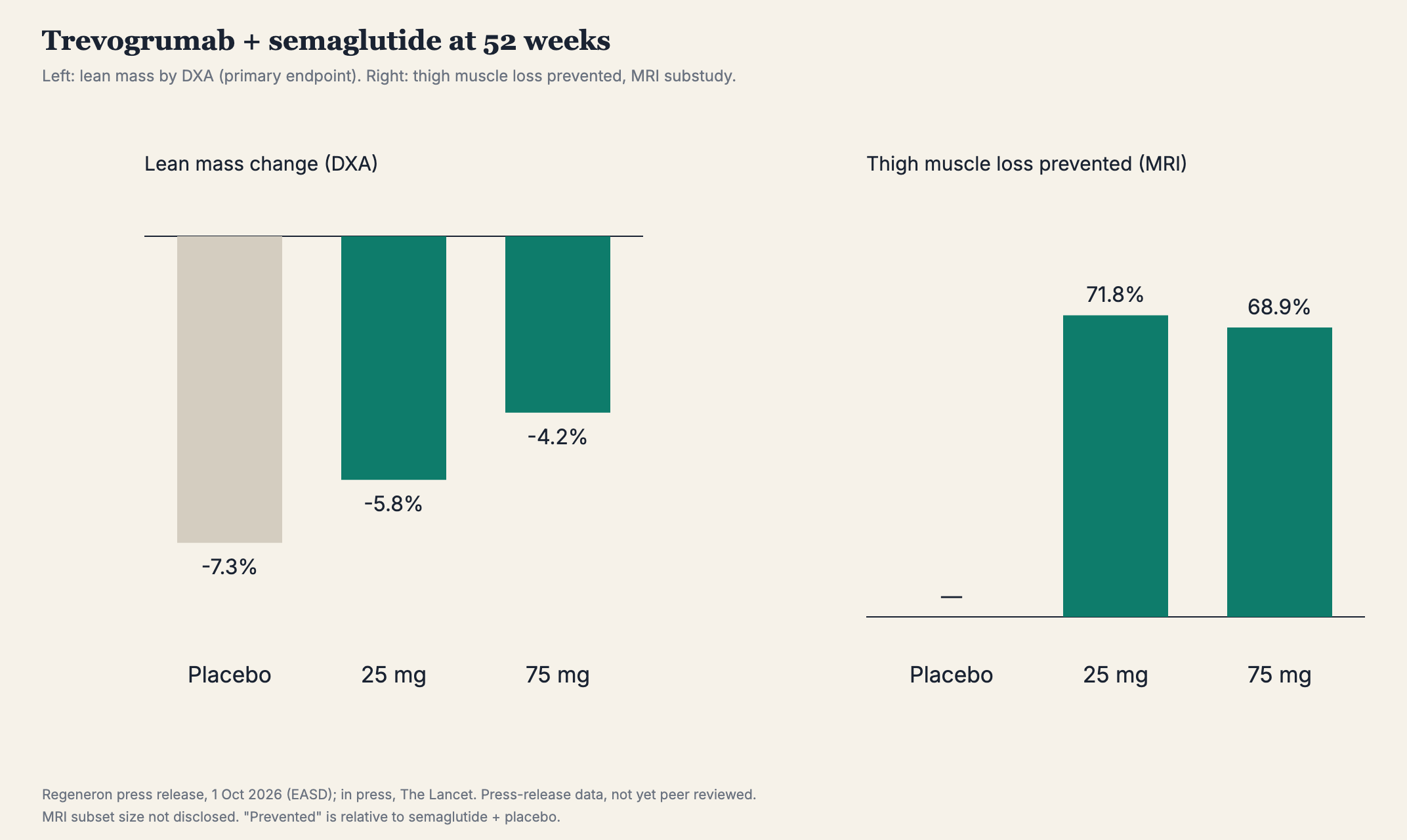
Lower-dose portion (52 weeks; the primary endpoint). Participants received semaglutide plus placebo, semaglutide plus trevogrumab 25 mg, or semaglutide plus trevogrumab 75 mg for a full year. Lean mass by dual-energy X-ray absorptiometry (DXA) was the primary endpoint and was met.¹
| Arm | Lean mass, week 26 | Lean mass, week 52 |
|---|---|---|
| Semaglutide + placebo | −6.7% (95% confidence interval −7.9 to −5.5) | −7.3% (−8.8 to −5.8) |
| + trevogrumab 25 mg | −4.7% (−5.5 to −3.9); 29.9% preserved | −5.8% (−6.8 to −4.7); 20.5% preserved |
| + trevogrumab 75 mg | −3.3% (−4.1 to −2.4); 50.7% preserved | −4.2% (−5.3 to −3.1); 42.5% preserved |
"Preserved" means the fraction of the semaglutide-alone lean loss that did not happen.¹ Read plainly: on semaglutide alone, participants lost about 7% of their lean mass in a year; with 75 mg of trevogrumab they lost about 4%. The effect was larger at 26 weeks than at 52, so some of the early protection eroded with time.¹
A predefined magnetic resonance imaging (MRI) substudy measured thigh muscle volume directly, which matters because DXA "lean mass" includes organs, water and connective tissue, not just muscle. In participants with evaluable scans, trevogrumab prevented roughly 69–72% of the thigh muscle loss seen with semaglutide alone at 52 weeks (absolute change −1.03 ± 0.22 with placebo vs −0.29 ± 0.12 with 25 mg and −0.32 ± 0.13 with 75 mg; units and substudy size were not disclosed).¹ Regeneron's headline — "prevented 70% of muscle loss" — comes from this substudy, not from the primary DXA endpoint. The two numbers (42.5% by DXA, ~70% by MRI) are both real and measure different things; the MRI figure likely isolates skeletal muscle better, but it comes from an unspecified subset.¹
Lower-dose trevogrumab "did not meaningfully enhance the weight loss achieved with semaglutide alone."¹ This is the single most important fact for interpreting the drug: it changes what is lost, not how much.
Higher-dose portion (26 weeks). Reported in September 2025, this portion tested 200 mg and 400 mg, plus a triple combination adding garetosmab (an anti-activin A antibody).² Least-squares means at week 26:
| Arm (n) | Lean mass | Lean kg (share of weight lost) | Fat mass | Body weight |
|---|---|---|---|---|
| Semaglutide + placebo (151) | −6.5% | −3.3 kg (33.0%) | −15.7% | −10.6% |
| + trevogrumab 200 mg (149) | −3.3% | −1.5 kg (16.8%) | −17.3% | −9.9% |
| + trevogrumab 400 mg (152) | −3.8% | −1.9 kg (18.1%) | −19.1% | −11.1% |
| + trevogrumab 400 mg + garetosmab (147) | −2.0% | −0.9 kg (7.4%) | −27.1% | −13.4% |
p<0.001 for lean mass in all trevogrumab arms versus semaglutide alone; p-values were not corrected for multiplicity.² Two observations. There is no dose-response: 200 mg did numerically better than 400 mg, and 75 mg later did about as well as either. And the triple combination with garetosmab was the only regimen that meaningfully increased total weight loss (trevogrumab 400 mg alone showed a modest, nominally significant increase in fat loss in kilograms) — but the triplet was also the arm with two deaths and a substantially higher discontinuation rate, and Regeneron has said it will not advance it.²˒³
2b. Older randomized evidence (sarcopenia trial completed 2016)
The Phase 2 sarcopenia trial (NCT01963598; n=253; age 70 and older, mean about 78; 12 weeks of subcutaneous dosing at 100 mg or 300 mg) has no peer-reviewed publication that we could identify and no results posted on the registry.⁴˒⁶ The only quantitative account is in Regeneron patent filings, which report placebo-adjusted total lean mass increases of up to about 2.3% (roughly 0.7–1.0 kg across dose arms) and "directionally greater" changes in strength and function.⁵ An independent review describes the strength and function results, including the 6-minute walk, as not statistically different from placebo.⁶ A 2025 review table lists the trial as showing no significant mass or function benefit — which conflicts with the patent's lean-mass claim.⁷ What the sources agree on: function did not measurably improve; whether lean mass rose meaningfully depends on which account one trusts. A trial in inclusion body myositis was withdrawn before enrolling.⁶
2c. Mechanistic and animal evidence
Myostatin is a member of the transforming growth factor-beta family, expressed mainly in skeletal muscle, that signals through activin type II receptors to suppress muscle protein synthesis and promote breakdown. Across several animal species, including humans, absence of myostatin is associated with increased muscle mass and strength (observational genetics, as summarized by Scholar Rock and in the EMBRAZE paper).⁸˒¹⁶ That is the entire rationale: block the brake, keep the muscle. It is a strong mechanism — but mechanism is not outcome, and the authors of EMBRAZE (the apitegromab-plus-tirzepatide trial) note that decades of myostatin-targeting programs failed, in their account because of off-target effects from poor selectivity or because they were tested in the wrong disease.⁸
2d. What has not been shown
No strength or physical-function outcome has been reported from COURAGE, and no numerical values for insulin sensitivity, glycemia or lipids.¹˒² Regeneron described only "numerical improvements" in waist, blood pressure, cholesterol, triglycerides and hemoglobin A1c across all arms, which is what semaglutide does on its own.² Whether roughly one and a half to two kilograms of retained lean mass (the difference between arms in the higher-dose portion) makes a person stronger, more insulin-sensitive, or less likely to fall remains untested.
3. Clinical relevance
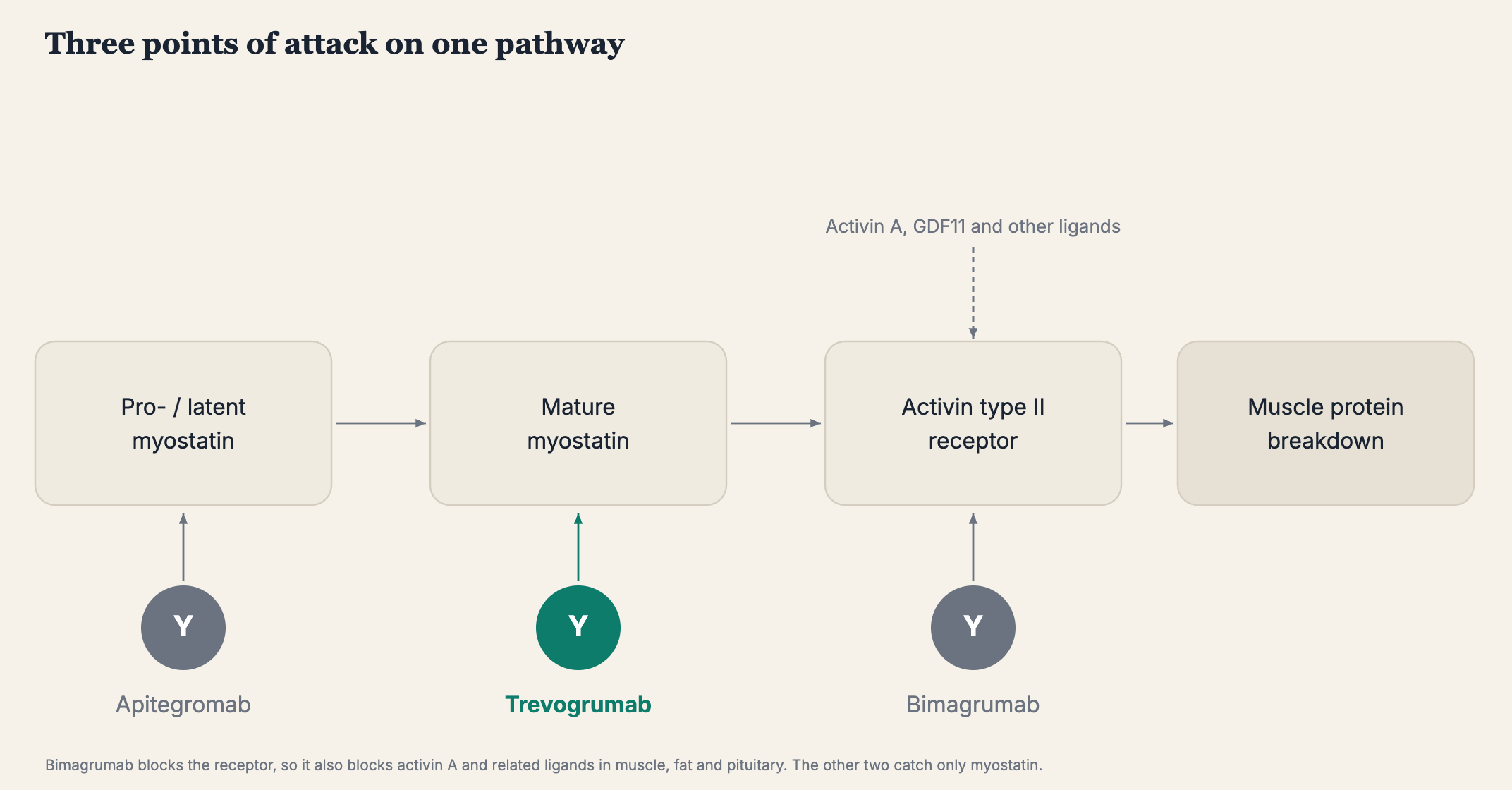
How I read the pathway. Three antibodies are chasing the same problem by hitting the pathway at different points.⁸˒⁹ Bimagrumab blocks the receptor itself, so it blocks myostatin and activin A and other ligands — in muscle and in fat and in the pituitary. That breadth is the plausible mechanistic explanation for why bimagrumab adds fat loss, and plausibly also for its reported muscle cramps, acne, and the reversible follicle-stimulating hormone drop seen in women — though those attributions are inference, not demonstrated causation.⁹˒¹⁷ Apitegromab binds the inactive precursor of myostatin and, by its developer's account, has no activity toward other members of the same growth-factor family. Trevogrumab neutralizes mature myostatin. In the trials to date, the ligand-selective drugs (trevogrumab, apitegromab) changed body composition without changing total weight loss; the receptor blocker changed both.⁸˒⁹ That is the central trade-off a clinician should hold in mind.
Safety as reported. In the lower-dose portion, 77% of trevogrumab-treated participants had at least one adverse event versus 82% with semaglutide and placebo; the most common events — nausea, constipation, diarrhea, vomiting — are the ones expected from semaglutide.¹ In the higher-dose portion, muscle spasms appeared on the list of events occurring in at least 5% of participants in any arm.² Discontinuation rates, serious adverse events and per-arm event tables have not been released for either portion.¹˒² Two deaths occurred in the triple-combination arm (one undetermined cause in a patient with multiple cardiovascular risk factors; one cardiac arrest in a person with known cardiovascular disease); Regeneron found no causal link.² Garetosmab, the third drug in that arm, had previously drawn a full US Food and Drug Administration (FDA) clinical hold (December 2020 to May 2022) after five deaths in a fibrodysplasia ossificans progressiva program.¹⁰ Whatever one concludes about causality, the triplet is dead, and the deaths occurred in the one arm that combined trevogrumab 400 mg with garetosmab; no deaths were reported in the trevogrumab-plus-semaglutide arms — but the field should want to see the full Lancet safety tables before saying more.
Who it might eventually be for. A pre-specified subgroup with low baseline lean mass (the imaging component of the Foundation for the National Institutes of Health sarcopenia definition — appendicular lean mass relative to body mass index) lost more lean mass on semaglutide alone and had "numerically more preservation" with trevogrumab; no numbers were released.¹ That subgroup is the clinically coherent target — older adults, or anyone starting a GLP-1 drug with little muscle to spare — and it is exactly the population Regeneron says its next Phase 2 will enroll.¹˒³ Note that COURAGE excluded people with diabetes, hypertrophic cardiomyopathy and specified electrocardiogram abnormalities.¹¹
Interactions. None published. The only human combination data are with semaglutide; no registered trial has paired trevogrumab with tirzepatide.¹¹
4. For You (practical)
This section is education, not a prescription. Framed as what the evidence would support discussing with your own physician:
- You cannot get this drug. It is Phase 2, has no regulatory filing, and Regeneron has not started a Phase 3.¹ Anything marketed as trevogrumab outside a trial is not the drug.
- If you are on a GLP-1 drug today, the lean-mass problem is real and quantified: in the trials that measured body composition by DXA, roughly 25–40% of weight lost was lean tissue.²˒⁸˒⁹ Resistance training and adequate protein were the counseled background in the trials that describe it — BELIEVE (the bimagrumab-plus-semaglutide trial) specified at least 1.2 g/kg/day of protein and 150 minutes of weekly activity; EMBRAZE counseled diet and physical activity without monitoring them; COURAGE has not described its lifestyle counseling⁸˒⁹ — but no trial has yet measured how much they protect muscle during incretin therapy specifically; the first such trials are only now enrolling.¹²
- If you are older or start with low muscle mass, you are the person this drug is being designed for, and the subgroup that lost the most lean mass on semaglutide alone in COURAGE.¹
- If a trial opens near you, the planned Regeneron study in older adults with obesity and low muscle mass or strength is the one to ask about.¹˒³
5. Uncertainty and open questions
- Peer review. Everything from COURAGE is press-release data as of this writing. The Lancet paper will add per-arm sizes, discontinuations, serious adverse events and the MRI substudy size. This monograph should be revised when it appears.¹
- Function. In the trials reviewed here — trevogrumab's own 2016 sarcopenia study, and the obesity trials of all three antibodies — no strength or mobility benefit has been demonstrated: COURAGE has reported none, EMBRAZE's exploratory function measures were null, and BELIEVE's grip-strength and physical-function results were largely no different from placebo.⁵⁻⁹ (Apitegromab did improve motor function in spinal muscular atrophy, a different disease and population.¹⁸) Regulators have said publicly that they do not yet know what endpoint should count.¹³
- DXA versus muscle. DXA lean mass includes water and organ tissue; the MRI substudy is more specific but smaller and undisclosed in size.¹ Semaglutide also reduces extracellular water (by about 0.9 L over 24 weeks in one bioimpedance study), and it is reasonable to infer — though not demonstrated — that some apparent lean-mass loss on DXA is water rather than muscle.¹⁴
- Durability. Protection was weaker at 52 weeks than at 26. What happens after stopping is unreported (the higher-dose portion's weight-maintenance phase has not been released).¹˒²
- Dose. No dose-response between 200 and 400 mg; 75 mg performed similarly. The pharmacology is not yet transparent.¹˒²
- Men. Sex breakdown has not been published. Men carry more muscle and lose it differently; the data may not generalize evenly.¹
- Is the problem as big as advertised? Observational bioimpedance data presented at the 2026 European Congress on Obesity found relative muscle mass preserved or increased in more than 70% of GLP-1 users.¹⁵ That is weaker methodology than the trial DXA data, but it is a reminder that "GLP-1 muscle loss" has become a marketing category before it became a measured clinical harm.
- Where the optimization space has run ahead. Gray-market "myostatin inhibitor" products, follistatin peptides and claims about "stacking" with semaglutide have no relation to this trial. Trevogrumab is an injectable antibody under investigational protocol, not a compounding-pharmacy product.
6. References
- Regeneron Pharmaceuticals. Phase 2 COURAGE Trial Confirms Trevogrumab Prevents Lean Mass and Muscle Loss During GLP-1 Receptor Agonist-induced Weight Loss. Press release, 1 Oct 2026 (European Association for the Study of Diabetes annual meeting; "in press with The Lancet"). https://www.globenewswire.com/news-release/2026/10/01/3373155/0/en/
- Regeneron Pharmaceuticals. Results from Phase 2 COURAGE Trial Demonstrating Potential to Improve Quality of GLP-1 receptor agonist-induced Weight Loss by Preserving Lean Mass, Presented at EASD. Press release, 17 Sep 2025. https://investor.regeneron.com/news-releases/news-release-details/results-phase-2-courage-trial-demonstrating-potential-improve
- Reuters, 1 Oct 2026 (syndicated via Emirates 24/7); FirstWord Pharma, 1 Oct 2026; Yahoo/Clinical Trials Arena, European Association for the Study of Diabetes (EASD) 2026 coverage of COURAGE including Regeneron's decision not to advance the garetosmab triplet and plans for a Phase 2 in older adults.
- ClinicalTrials.gov NCT01963598. Study of the Safety and Efficacy of REGN1033 (SAR391786) in Patients With Sarcopenia. Completed; no results posted.
- US Patent 12,029,788 (Regeneron). Methods for increasing lean body mass with an exercise regimen and a GDF8 inhibitor — Example 3, clinical trial of REGN1033 in sarcopenia (patent text: 250 enrolled, mean age 78; registry: 253 actual).
- SARA-INT protocol (NCT03452488), background section summarizing REGN1033 sarcopenia results: lean mass gain without significant strength/function benefit; program apparently discontinued. Inclusion body myositis trial: ClinicalTrials.gov NCT03710941 (withdrawn).
- Review table, PMC12963776 (Endocrinol Metab [Seoul] 2025), summarizing anti-myostatin agents in sarcopenia.
- Pratley RE, et al. Apitegromab for lean mass preservation during tirzepatide-induced weight loss: a randomized, double-blind, placebo-controlled phase 2 trial. Nat Med. 2026 Jun 8. https://doi.org/10.1038/s41591-026-04440-4 (introduction and discussion on myostatin biology and the history of failed myostatin programs).
- Heymsfield SB, et al. Bimagrumab plus semaglutide alone or in combination for the treatment of obesity: a randomized phase 2 trial. Nat Med. 2026 Mar 2. https://doi.org/10.1038/s41591-026-04204-0 (pathway biology; 25–40% lean share of weight loss; grip strength and function results).
- US Food and Drug Administration. Risk assessment review, garetosmab Biologics License Application 761508 (2026): full clinical hold 2 Dec 2020 following a fifth fatal serious adverse event in LUMINA-1; hold lifted 12 May 2022.
- ClinicalTrials.gov NCT06299098. COURAGE: trevogrumab with or without garetosmab plus semaglutide in obesity — eligibility criteria.
- ClinicalTrials.gov NCT07761923. Preserving Muscle Mass During Incretin-Induced Weight Loss (INCRETraIN; official title: Resistance Exercise Training to Preserve Muscle Mass and Physical Function During Incretin-Based Weight Loss). Karolinska Institutet. Recruiting; start Oct 2026.
- Society on Cachexia and Wasting Disorders. Muscle Loss in Obesity Therapy as a Therapeutic Target: Trial Design and Endpoints for Regulatory Discussions. J Cachexia Sarcopenia Muscle. 2025 Dec. https://doi.org/10.1002/jcsm.70147
- Effects of Semaglutide on Body Composition and GFR [glomerular filtration rate]: A Prespecified Analysis of the SMART Trial. Clin J Am Soc Nephrol. 2026 Apr 30. https://doi.org/10.2215/CJN.0000001051 (extracellular water −0.9 L with semaglutide).
- European Congress on Obesity 2026 (Istanbul, 12–15 May), bioimpedance cohort: fat −9.0 kg, skeletal muscle −1.2 kg; relative muscle mass preserved or increased in >70%. Reported by Medical Xpress, May 2026. Conference abstract; observational.
- Scholar Rock. EMBRAZE topline press release, June 2025: myostatin "absence is associated with increased muscle mass and strength across multiple animal species, including humans."
- Garito T, et al. Effects of bimagrumab, an activin receptor type II inhibitor, on pituitary neurohormonal axes. Clin Endocrinol. 2018. https://doi.org/10.1111/cen.13601
- Crawford TO, Servais L, Mercuri E, et al. Safety and efficacy of apitegromab in nonambulatory type 2 or type 3 spinal muscular atrophy (SAPPHIRE): a phase 3, double-blind, randomised, placebo-controlled trial. Lancet Neurol. 2025;24(9):727-739. https://doi.org/10.1016/S1474-4422(25)00225-X
7. Disclaimer
This monograph is physician-led educational content. It is not medical advice, and it does not diagnose, treat, or establish a doctor-patient relationship. Compounds discussed may carry risks and interactions specific to your health. Trevogrumab is an investigational drug that is not approved for any use. Talk with your own physician before making changes.