Overview
Plant sterols (also called phytosterols) and their close relatives, plant stanols, are plant-made molecules shaped almost exactly like cholesterol. Small amounts occur naturally in vegetable oils, nuts, seeds and grains. Larger amounts are added to spreads, yogurt drinks, milk and dressings, or sold as capsules.
Because they look like cholesterol, they compete with it in the gut, so less is absorbed and blood LDL (low-density lipoprotein) cholesterol, the "bad" cholesterol, falls.
They are on men's radar because they are one of the few non-prescription products with a large, consistent body of randomized trials showing a drop in LDL cholesterol, and US labels may mention heart disease. The harder question: has anyone shown that the drop means fewer heart attacks, strokes or deaths? As of November 2026, no.
In the United States these products are sold as foods and dietary supplements. The US Food and Drug Administration (FDA) allows a qualified heart-health claim on certain foods, which is a labeling rule, not a drug approval.
Evidence
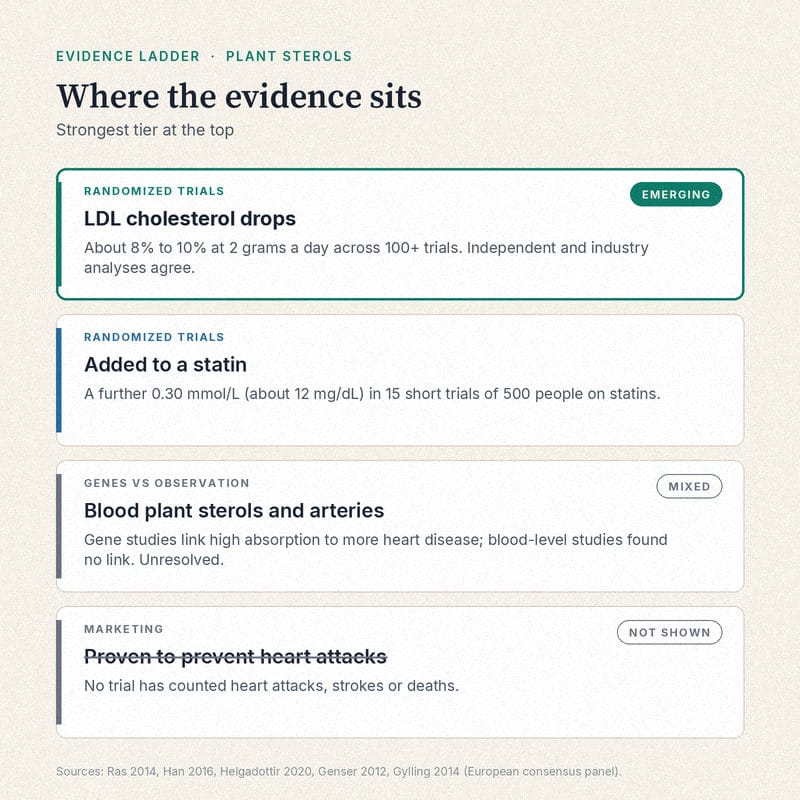
Graded strongest first, from randomized trials down to marketing claims. Industry ties are stated next to each study.
Randomized controlled trials: LDL cholesterol (the strongest tier)
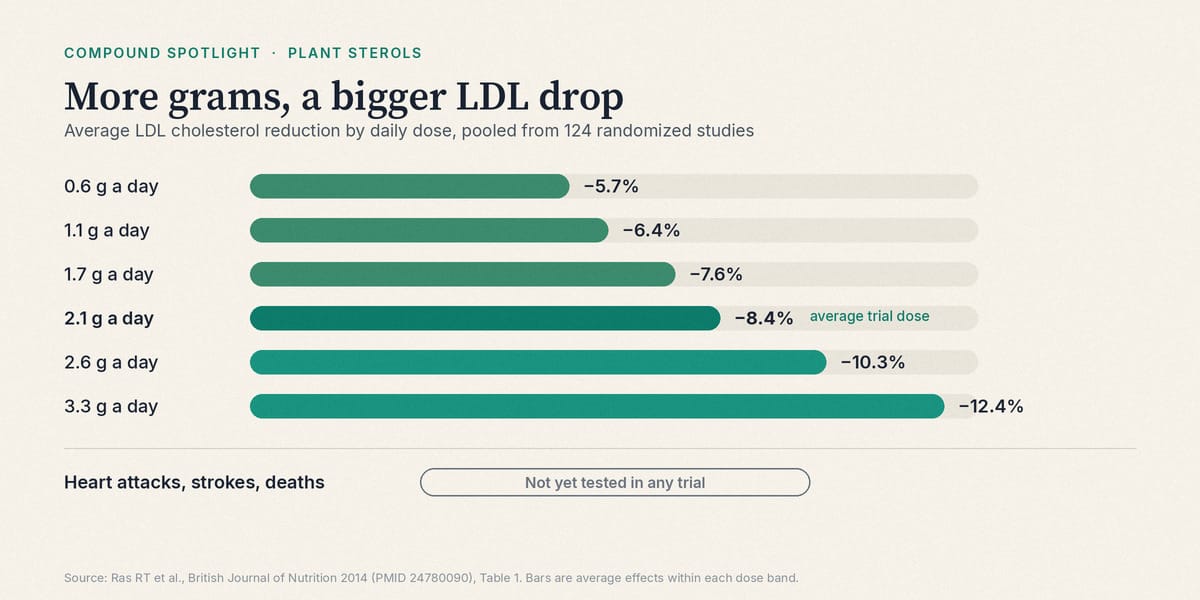
Ras and colleagues, 2014 (British Journal of Nutrition; PMID 24780090; full text read). The largest dose analysis: 124 randomized studies, average dose 2.1 grams a day. Intakes of 0.6 to 3.3 grams a day lowered LDL cholesterol by 6% to 12%. In the 2.0 to 2.5 gram band (average 2.1 grams), LDL cholesterol fell 8.4% (95% confidence interval 7.6% to 9.2%). In the 3.0 to 4.0 gram band (average 3.3 grams), it fell 12.4%. Sterols and stanols behaved alike. Two of three authors worked for Unilever, which sells sterol-enriched foods.
Demonty and colleagues, 2009 (Journal of Nutrition; PMID 19091798; abstract read). 84 randomized trials. At an average 2.15 grams a day, LDL cholesterol fell 0.34 mmol/L (about 13 mg/dL), or 8.8% (95% confidence interval 8.3% to 9.4%). Unilever authors.
AbuMweis and colleagues, 2008 (Food & Nutrition Research; PMID 19109655; full text read). 59 randomized trials published 1992 to 2006. Plant sterol products lowered LDL cholesterol by 0.31 mmol/L (about 12 mg/dL; 95% confidence interval 0.27 to 0.35 mmol/L) compared with placebo. Effects were larger in spreads, dressings, milk and yogurt than in baked goods, juice and cereal bars. A single morning dose did not have a significant effect. One author disclosed consulting for Danone and Unilever.
Katan and colleagues, 2003 (expert workshop, Mayo Clinic Proceedings; PMID 12911045; abstract read). 41 trials: about 10% at 2 grams a day; about 20% combined with a low saturated-fat diet.
Replication. These overlapping pooled analyses span three decades and agree: about 8% to 10% at 2 grams a day. A 2026 umbrella review of 14 earlier systematic reviews (Zurbau and colleagues, Clinical Nutrition; PMID 42275989; abstract read) rated the certainty of the LDL cholesterol effect as generally high and found reductions of at least 0.2 mmol/L (about 8 mg/dL) beginning at doses as low as 0.5 to 1 gram a day.
Randomized controlled trials: added to a statin
Han and colleagues, 2016 (Scientific Reports; PMID 27539156; full text read). 15 randomized trials, 500 people already taking statins. Adding sterol- or stanol-enriched foods lowered LDL cholesterol by a further 0.30 mmol/L (about 12 mg/dL; 95% confidence interval 0.25 to 0.35 mmol/L) compared with the statin alone. HDL cholesterol (high-density lipoprotein, the "good" kind) and triglycerides did not change. Trials were short: a median of 6 weeks (range 4 to 85), median dose 2.5 grams. Funded by Nestlé, with four Nestlé authors.
European Atherosclerosis Society consensus panel, 2014 (Gylling and colleagues, Atherosclerosis; PMID 24468148; abstract read). The panel judged that 2 grams a day lowers LDL cholesterol by 8% to 10% and that the effect adds to a statin by about as much as doubling the statin dose. The same panel wrote that there are "no randomised, controlled clinical trial data with hard end-points to establish clinical benefit."
Randomized controlled trials: people with inherited high cholesterol
Malhotra and colleagues, 2014 (Cochrane review of familial hypercholesterolaemia, an inherited form of very high LDL cholesterol; PMID 24913720). 15 short trials, 453 participants. Plant sterols lowered LDL cholesterol by 0.60 mmol/L (about 23 mg/dL; 95% confidence interval 0.31 to 0.89 mmol/L) compared with a cholesterol-lowering diet alone. None of the trials measured heart disease, deaths or age at death.
DICA-FH pilot, 2025 (de Abreu-Silva and colleagues, Nutrients; PMID 40573119; abstract read). 58 adults with familial hypercholesterolaemia got 2 grams a day of phytosterols or placebo on top of a heart-healthy diet for 120 days. LDL cholesterol did not differ between groups, though the pilot was not powered to detect a difference. A 300-person trial was due to finish follow-up in July 2026 (PMID 42285576); no results yet.
Randomized controlled trials: beyond LDL cholesterol
The 2026 umbrella review (PMID 42275989) found systolic blood pressure about 1.6 mmHg lower and no change in fasting blood sugar, weight or waist size. A 2026 pooled analysis of 10 randomized trials with 1,278 participants (Zamanian and colleagues, BMC Nutrition; PMID 42947265; abstract read) found no effect on flow-mediated dilation, a test of how well arteries widen (difference −0.05%, 95% confidence interval −0.61 to 0.51).
Randomized controlled trials: safety markers
Baumgartner and colleagues, 2017 (European Journal of Nutrition; PMID 27591863; full text read). 41 randomized trials, 3,306 people, average intake 2.5 grams a day. Blood beta-carotene fell 16.3% (10.1% after adjusting for the lower cholesterol that carries it). Retinol (vitamin A) and vitamin D were not affected. Vitamin E, adjusted for cholesterol, did not change. All levels stayed within normal ranges. Supported by a Unilever grant, with two Unilever authors.
The outcome question: the gap
No randomized trial has tested whether plant sterols reduce heart attacks, strokes or deaths; the consensus panel and the Cochrane review both say so. The closest evidence is indirect:
- The general LDL rule. In the Cholesterol Treatment Trialists' analysis of 26 statin trials and about 170,000 people (Lancet 2010; PMID 21067804; full text read), each 1 mmol/L (about 39 mg/dL) reduction in LDL cholesterol came with a 22% lower rate of major vascular events (rate ratio 0.78, 95% confidence interval 0.76 to 0.80). Plant sterols lower LDL by roughly a third of that; applying the statin rule to them is a projection, not a measured result.
- A drug that works at the same step. Ezetimibe is a prescription drug that also blocks cholesterol absorption in the gut. In IMPROVE-IT (N Engl J Med 2015; PMID 26039521; abstract read), 18,144 people after an acute coronary event got a statin plus ezetimibe or plus placebo, followed a median of 6 years. Average LDL cholesterol was 53.7 versus 69.5 mg/dL, and the main combined event rate at 7 years was 32.7% versus 34.7% (hazard ratio 0.936). Merck, which made ezetimibe, funded it. Blocking absorption can pay off; that does not show plant sterols, which also raise blood plant sterols, do the same.
Genetic and observational studies: the open safety question
Added plant sterols raise blood plant sterol levels (Katan 2003). Whether that matters is the main scientific argument about them.
Helgadottir and colleagues, 2020 (European Heart Journal; PMID 32702746; full text read). Gene variants in the transporters that pump sterols back out of the gut (ABCG5 and ABCG8) were studied in 105,490 coronary disease cases and 844,025 controls. Carriers of variants that raise sterol absorption had higher blood plant sterols. A genetic score from these variants that predicted a 1 mmol/L rise in non-HDL cholesterol was associated with about twice the odds of coronary disease (odds ratio 2.01, 95% confidence interval 1.75 to 2.31), compared with a 54% rise (odds ratio 1.54) for other variants with the same cholesterol effect. The authors inferred that plant sterols themselves contribute to artery disease; that inference was contested in published correspondence (reply, PMID 33167008). Funded by deCODE genetics/Amgen.
Scholz and colleagues, 2022 (Nature Communications; PMID 35013273; full text read). A gene study of up to 9,758 people using Mendelian randomization (inherited variants as a natural experiment) reported a risk-increasing link between blood sitosterol and coronary disease, partly explained by cholesterol.
Genser and colleagues, 2012 (European Heart Journal; PMID 22334625; full text read). 17 observational studies with 11,182 participants found no association between blood sitosterol or campesterol and cardiovascular disease. The authors noted possible publication bias; the lead author had a Danone grant.
Simonen and colleagues, 2026 (Journal of Lipid Research; PMID 41478357; full text read). An exploratory Finnish study of 363 people followed about 9.5 years. Markers of high cholesterol absorption, including blood plant sterols, were associated with more heart events in people who had already had an acute coronary event, not in people without coronary disease. Association only.
How to read this tier. Being born a high sterol absorber is associated with more coronary disease than cholesterol alone predicts. That does not test added sterols in everyone else. Observational blood-level studies found no link. The tiers conflict, neither is a randomized trial, and the question is open.
Regulators
FDA, 21 CFR 101.83. Labels may say that diets low in saturated fat and cholesterol that include plant sterol or stanol esters "may" or "might" reduce the risk of heart disease, at daily intakes of at least 1.3 grams of sterol esters or 3.4 grams of stanol esters, in two servings at different times of day with other foods. The claim may not state any degree of risk reduction. Ester weights are higher than the free sterol amounts used in most trials.
Marketing claims
"Proven to prevent heart attacks" is not supported: no trial has counted heart attacks. "More is better" is only partly true: the gain flattens near 3 grams at about 12%. A single morning dose is the least-supported pattern (AbuMweis 2008).
Clinical relevance
Mechanism (labelled as mechanism). Plant sterols displace cholesterol from the tiny fat droplets that carry it across the gut lining, and the ABCG5 and ABCG8 transporters pump most absorbed plant sterols back out. Less cholesterol reaches the liver, the liver pulls more LDL from the blood, and the level falls. That it needs cholesterol in the gut is the plausible reason it works better with meals.
Dose ranges from the literature. Trials cluster around 1.5 to 3 grams a day of free sterol or stanol, split across meals, mostly in enriched foods rather than capsules.
Who should not use it. People with sitosterolemia, a rare inherited disorder caused by faulty ABCG5 or ABCG8 genes. Blood sitosterol runs 30 to 100 times normal, fatty deposits can clog arteries as early as childhood, and the condition may affect at least 1 in 50,000 people (MedlinePlus Genetics). Treatment includes restricting plant sterols and taking ezetimibe (Yoo 2016, PMID 27104173). Clues that prompt testing include fatty skin or tendon deposits with normal cholesterol, an unusually large response to diet or ezetimibe, or a poor response to statins (Yoo 2016).
Interactions and nutrients. Ezetimibe works on the same absorption step, so combining them is a question for the prescribing clinician. Beta-carotene falls modestly; vitamins A and D did not (Baumgartner 2017).
Monitoring. Trials saw the effect within weeks. A repeat lipid panel after a few weeks of steady use shows whether it worked for a given person.
Who the consensus panel had in mind. The 2014 European panel said these foods "may be considered" for people with high cholesterol at low or intermediate risk who do not qualify for drugs, as an add-on for high-risk patients not at goal on (or unable to take) statins, and for adults and children over 6 with familial hypercholesterolaemia. Not as a replacement for a needed statin.
For you
This section is education, not a recommendation.
Who might benefit. Someone with mildly raised LDL cholesterol who is working on diet and wants a modest extra drop. Someone on a statin close to, but not at, their LDL goal. Someone who cannot tolerate a statin and is discussing alternatives.
Who probably would not. Someone whose LDL cholesterol is already low. Someone who needs a large LDL reduction, such as after a heart attack: an 8% to 10% drop is not a substitute for proven drug therapy. Anyone with sitosterolemia or a family history of it.
Questions to bring to your physician:
- "My LDL cholesterol is [your number]. Is a drop of about 8% to 10% meaningful for me, or do I need more than that?"
- "I am on a statin (or ezetimibe). Does adding plant sterols make sense, and when should we recheck my lipid panel?"
- "Do I have any features that would make you want to rule out sitosterolemia first?"
- "Should I be thinking about my beta-carotene intake with daily use?"
If you and your physician try it, the trial pattern is about 2 grams a day of free sterol or stanol, split across two meals, in a food that contains some fat, with a recheck of LDL cholesterol after a few weeks. Talk with your physician before making changes.
Uncertainty and open questions
- No outcome trial. Every heart-protection claim rests on the LDL rule plus indirect evidence.
- The blood plant sterol question. Gene studies and observational studies disagree, and neither tests added sterols in ordinary people. This is the biggest unknown.
- Short trials. Most lasted weeks to months; effects over decades are unknown.
- Industry authorship. Several of the largest analyses were written or funded by sellers. Independent analyses agree on the LDL effect, but the funding should be weighed.
- Capsules versus foods. Capsules are less well studied than enriched foods.
- Where the marketing has outrun the science. Labels that lead with heart disease suggest a tested outcome that does not exist; the FDA rule itself requires "may" and bars any stated size of benefit.
What would change the verdict. A randomized trial counting heart events would settle it. Clear evidence that diet-driven rises in blood plant sterols harm arteries would push the verdict down.
Verdict
EMERGING. Plant sterols and stanols reliably lower LDL cholesterol by about 8% to 10% at 2 grams a day, including on top of a statin, but no randomized trial has shown fewer heart attacks, strokes or deaths, and the question of raised blood plant sterols remains open.
References
- Ras RT et al. LDL-cholesterol-lowering effect of plant sterols and stanols across different dose ranges: a meta-analysis of randomised controlled studies. Br J Nutr. 2014;112(2):214-219. PMID 24780090
- Demonty I et al. Continuous dose-response relationship of the LDL-cholesterol-lowering effect of phytosterol intake. J Nutr. 2009;139(2):271-284. PMID 19091798
- AbuMweis SS et al. Plant sterols/stanols as cholesterol lowering agents: a meta-analysis of randomized controlled trials. Food Nutr Res. 2008;52. PMID 19109655
- Katan MB et al. Efficacy and safety of plant stanols and sterols in the management of blood cholesterol levels. Mayo Clin Proc. 2003;78(8):965-978. PMID 12911045
- Zurbau A et al. Efficacy of phytosterols for reduction of cardiometabolic risk factors: an umbrella review and updated dose-response meta-analyses of randomized trials. Clin Nutr. 2026. PMID 42275989
- Han S et al. Effects of plant stanol or sterol-enriched diets on lipid profiles in patients treated with statins: systematic review and meta-analysis. Sci Rep. 2016;6:31337. PMID 27539156
- Gylling H et al. Plant sterols and plant stanols in the management of dyslipidaemia and prevention of cardiovascular disease. Atherosclerosis. 2014;232(2):346-360. PMID 24468148
- Malhotra A et al. Dietary interventions (plant sterols, stanols, omega-3 fatty acids, soy protein and dietary fibers) for familial hypercholesterolaemia. Cochrane Database Syst Rev. 2014;(6):CD001918. PMID 24913720
- de Abreu-Silva EO et al. An adapted cardioprotective diet with or without phytosterol and/or krill oil supplementation in familial hypercholesterolemia: results of a pilot randomized clinical trial. Nutrients. 2025;17(12):2008. PMID 40573119
- de Abreu-Silva EO et al. Effect of a culturally adapted heart-healthy diet with phytosterols and/or krill oil on lipid-related outcomes in familial hypercholesterolaemia: protocol for a multicentre randomised controlled trial in Brazil. BMJ Open. 2026. PMID 42285576
- Zamanian N et al. The effect of phytosterol supplementation on endothelial function in adults: a systematic review and dose-response meta-analysis of randomized controlled trials. BMC Nutr. 2026. PMID 42947265
- Baumgartner S et al. Plasma fat-soluble vitamin and carotenoid concentrations after plant sterol and plant stanol consumption: a meta-analysis of randomized controlled trials. Eur J Nutr. 2017;56(3):909-923. PMID 27591863
- Cholesterol Treatment Trialists' (CTT) Collaboration. Efficacy and safety of more intensive lowering of LDL cholesterol: a meta-analysis of data from 170,000 participants in 26 randomised trials. Lancet. 2010;376(9753):1670-1681. PMID 21067804
- Cannon CP et al. Ezetimibe added to statin therapy after acute coronary syndromes (IMPROVE-IT). N Engl J Med. 2015;372(25):2387-2397. PMID 26039521
- Helgadottir A et al. Genetic variability in the absorption of dietary sterols affects the risk of coronary artery disease. Eur Heart J. 2020;41(28):2618-2628. PMID 32702746
- Helgadottir A et al. Increased absorption of phytosterols is the simplest and most plausible explanation for coronary artery disease risk not accounted for by non-HDL cholesterol in high cholesterol absorbers (reply). Eur Heart J. 2021. PMID 33167008
- Scholz M et al. Genome-wide meta-analysis of phytosterols reveals five novel loci and a detrimental effect on coronary atherosclerosis. Nat Commun. 2022;13(1):143. PMID 35013273
- Genser B et al. Plant sterols and cardiovascular disease: a systematic review and meta-analysis. Eur Heart J. 2012;33(4):444-451. PMID 22334625
- Simonen P et al. High cholesterol absorption efficiency increases the risk of the nonfatal and fatal atherosclerotic events. J Lipid Res. 2026;67(2):100974. PMID 41478357
- Yoo EG. Sitosterolemia: a review and update of pathophysiology, clinical spectrum, diagnosis, and management. Ann Pediatr Endocrinol Metab. 2016;21(1):7-14. PMID 27104173
- MedlinePlus Genetics. Sitosterolemia. US National Library of Medicine. https://medlineplus.gov/genetics/condition/sitosterolemia/
- Code of Federal Regulations. 21 CFR 101.83, Health claims: plant sterol/stanol esters and risk of coronary heart disease. https://www.govinfo.gov/content/pkg/CFR-2025-title21-vol2/pdf/CFR-2025-title21-vol2-sec101-83.pdf
Disclaimer
Vanguard Optimization provides physician-led, evidence-based education only. This monograph is not medical advice, does not diagnose or treat, and does not establish a physician–patient relationship. Compounds discussed may carry risks and interactions specific to your health. Talk with your own physician before making changes.