Lane: Supplements
Author: Kristopher Crawford
Verdict: WEAK
Slug: nac-drug-antidote-real-capsule-claims-weak
URL: https://www.vanguardoptimization.com/blog/nac-drug-antidote-real-capsule-claims-weak/
Overview
N-acetylcysteine (often sold as NAC) is the N-acetyl derivative of the amino acid L-cysteine. In hospitals it is a staple antidote. On store shelves and in wellness clinics it is marketed as a "master antioxidant," a hangover fix, an immunity shield, a psychiatric adjunct, and sometimes an intravenous "detox" drip.
Those are not the same object. The Food and Drug Administration (FDA) labels intravenous acetylcysteine (Acetadote) to prevent or lessen hepatic injury after potentially hepatotoxic acetaminophen ingestion, with a total intravenous dose of 300 mg/kg given over about 20–21 hours as a two-bag or three-bag regimen. Oral acetylcysteine solution has a parallel antidote indication with a multi-day dosing protocol. Inhaled acetylcysteine is labeled as a mucolytic for abnormal or viscid mucous secretions, with an explicit bronchospasm warning. None of those labels endorses a 600 mg Amazon capsule for longevity, immunity, or hangover prevention.
Men's-health and optimization marketing borrowed the drug's biochemistry (glutathione replenishment after acetaminophen toxicity) and stretched it across claims the randomized evidence does not carry. This monograph grades the drug indication separately from the sold wellness product.
Evidence
Drug indication — acetaminophen antidote (strongest tier)
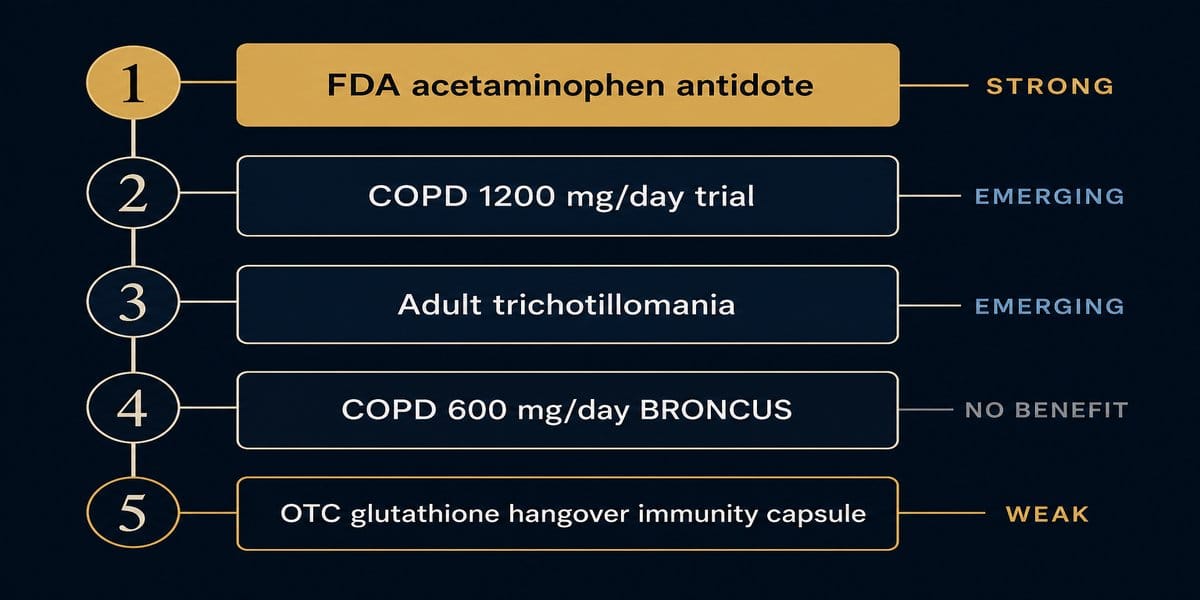
Acetadote is indicated to prevent or lessen hepatic injury after acute or repeated-supratherapeutic acetaminophen ingestion in patients who weigh 5 kg or greater. The labeled total intravenous dose is 300 mg/kg. Hypersensitivity reactions (including rash, urticaria, flushing, and rarely anaphylaxis) are documented; asthmatic patients require careful monitoring. Fluid overload is a labeled risk with intravenous administration. This is hospital toxicology, not a wellness protocol. Grade for the labeled antidote use: STRONG (regulator label plus decades of clinical practice). Grade for equating that label with over-the-counter capsule wellness: not applicable — different indication.
Chronic obstructive pulmonary disease — oral trials
BRONCUS (Decramer et al., Lancet 2005; PMID 15866309). Randomized controlled trial (placebo-controlled) in 523 patients with chronic obstructive pulmonary disease (COPD), N-acetylcysteine 600 mg once daily versus placebo for three years. Primary endpoints: yearly forced expiratory volume in one second (FEV1) decline and exacerbations per year. FEV1 decline: 54 mL/year versus 47 mL/year (difference 8 mL; 95% CI −25 to 10) — null. Exacerbations: 1.25 versus 1.29 per year; hazard ratio 0.99 (0.89–1.10), p=0.85 — null. Authors' conclusion: ineffective for preventing lung-function decline and exacerbations at this dose.
PANTHEON (Zheng et al., Lancet Respiratory Medicine 2014; PMID 24621680). Randomized, double-blind trial in 1,006 Chinese patients with moderate-to-severe COPD; N-acetylcysteine 600 mg twice daily (1,200 mg/day) versus placebo for one year. Primary annual exacerbation rate: 1.16 versus 1.49 per patient-year; risk ratio 0.78 (0.67–0.90), p=0.0011. Well tolerated in that trial. Interpretation is limited to the studied dose, duration, and population; correspondence debated generalizability beyond the Chinese cohort. Grade: EMERGING for high-dose exacerbation reduction in that setting — not proof that a low-dose antioxidant capsule modifies disease or longevity.
Dose matters inside the same molecule: 600 mg/day failed BRONCUS primaries; 1,200 mg/day reduced exacerbations in PANTHEON.
Psychiatric and habit indications — mixed, often null on later primaries
Bipolar depression. Berk et al. (Biological Psychiatry 2008; PMID 18534556): maintenance bipolar sample (n=75), N-acetylcysteine 1 g twice daily (2 g/day) for 24 weeks adjunctive. Montgomery–Åsberg Depression Rating Scale (MADRS) least-squares mean difference −8.05 (95% CI −13.16 to −2.95), p=.002 — positive on MADRS; time to mood episode null (log-rank p=.968); benefit lost after washout. A later acute bipolar depression trial (Ellegaard/Poulsen group with Berk coauthorship, Journal of Affective Disorders 2019; PMID 30699846; n=80; 3 g/day ×20 weeks) found primary MADRS between-group difference 0.5 (95% CI −7.0 to 5.9), p=0.88 — null, with high placebo response noted. Grade for a sold "psych stack": mixed / WEAK — early positive not confirmed on the later acute primary.
Trichotillomania. Grant et al. (Archives of General Psychiatry 2009; PMID 19581567): adults n=50; 1,200–2,400 mg/day ×12 weeks; Massachusetts General Hospital Hair Pulling Scale P<.001 versus placebo; Clinical Global Impression much/very much improved 56% versus 16% (P=.003). Bloch et al. (Journal of the American Academy of Child and Adolescent Psychiatry 2013; PMID 23452680): pediatric n=39, ages 8–17, titrated to 2,400 mg/day ×12 weeks; primary scale null; responders 25% versus 21%. Grade: EMERGING in adults with trichotillomania; not shown in children. Not a general anxiety or obsessive–compulsive disorder pill.
Obsessive–compulsive disorder. Sarris et al. (CNS Drugs 2015; PMID 26374743): n=44; 3 g/day ×16 weeks; intention-to-treat Yale–Brown Obsessive Compulsive Scale time×treatment p=0.39 — null primary. Costa et al. (Journal of Clinical Psychiatry 2017; PMID 28617566): treatment-resistant obsessive–compulsive disorder n=40; 3,000 mg/day ×16 weeks; Yale–Brown change −4.3 versus −3.0; between-group P=.92 — null. Grade for sold obsessive–compulsive claims: no benefit on these primaries.
Male fertility — semen labs, not live birth
Safarinejad & Safarinejad (Journal of Urology 2009; PMID 19091331) and Ciftci et al. (Urology 2009; PMID 19428083) reported improvements in some semen parameters with 600 mg/day oral N-acetylcysteine over weeks to months. A 2021 meta-analysis (Zhou et al., Andrologia; PMID 33405232; three randomized trials, 431 men) reported mean differences versus placebo for concentration, volume, motility, and morphology, with hormones nonsignificant. These are laboratory semen endpoints in small trials — not pregnancy or live-birth outcomes. Grade: WEAK / EMERGING for semen parameters; not a fertility cure.
COVID-19 and immunity — high-dose randomized primary null
de Alencar et al. (Clinical Infectious Diseases 2021; PMID 32964918): severe COVID-19, n=135; intravenous N-acetylcysteine approximately 21 g (about 300 mg/kg) over 20 hours versus dextrose. Primary mechanical ventilation: 20.6% versus 23.9% (P=.675) — null. Secondary intensive-care and mortality endpoints did not favor routine use in that trial. Subsequent randomized syntheses have not cleared a routine-use bar for COVID or general "immunity" capsules. Grade for immunity/COVID capsule or drip marketing: no benefit / HYPE relative to sold claims.
Intravenous wellness drips
No opened randomized trial establishes wellness-clinic intravenous N-acetylcysteine for hangover, "detox," or longevity endpoints as sold. Hospital acetaminophen protocols are not spa drips. Grade: HYPE.
Current-research pass (approximately last 18 months)
Specialty exploratory work continues: small randomized or pilot studies in traumatic brain injury, progressive multiple sclerosis biomarkers, vascular mild cognitive impairment (null on executive primary in one cardiac-rehabilitation trial), and neurofibromatosis type 1 motor/cognitive outcomes (null in a pediatric pilot). None of these rescues the over-the-counter glutathione–longevity–hangover–immunity marketing story. A 2026 neurological systematic review across several disorders still describes fragmented evidence and calls for larger standardized trials. The WEAK grade for sold capsule claims stands.
Clinical relevance
Mechanism (labelled as mechanism). Acetylcysteine can replenish glutathione and act as an alternate substrate for conjugation of the reactive acetaminophen metabolite — the pharmacology behind the antidote label. That mechanism is plausible as a general antioxidant story; it is not itself a clinical outcome for retail capsules.
Safety and who should not. Intravenous use: hypersensitivity (including anaphylaxis risk), asthma caution, fluid overload. Inhaled route: unpredictable airways obstruction / bronchospasm; discontinue if bronchospasm progresses. Oral supplemental doses in trials are generally well tolerated at studied ranges; gastrointestinal upset can occur. Hypersensitivity to acetylcysteine is a contraindication on the injection label. People with asthma need clinician supervision for any non-trivial exposure route. Do not equate hospital protocols with self-directed high-dose or intravenous wellness use.
Monitoring and interactions. Acetaminophen overdose care is poison-center and emergency-medicine territory (labs, nomogram timing, continuation decisions). For oral supplemental use discussed in research, clinicians may weigh COPD exacerbation history, psychiatric comorbidity, and concurrent medications; there is no universal consumer monitoring panel that turns a capsule into an antidote.
Literature dose ranges (education only — not a personal prescription). Antidote: per FDA label, total intravenous 300 mg/kg over ~20–21 hours (or oral multi-day antidote protocols under clinical supervision). COPD research doses: 600 mg/day (BRONCUS, null primaries) versus 1,200 mg/day (PANTHEON). Psychiatric and trichotillomania trials often used 1–3 g/day for weeks to months under study protocols. Retail bottles commonly sell 600–1,200 mg/day — the dose band where COPD results already diverge by indication and population.
For you (practical)
This section is education for conversations with your own physician — not a recommendation to start, stop, or dose anything.
Questions to bring to one's own physician:
- If the interest is acetaminophen safety after a large ingestion or repeated high dosing — that is an emergency / poison-center problem, not a supplement aisle decision.
- If the interest is COPD exacerbations — ask whether high-dose oral N-acetylcysteine evidence (including PANTHEON's population limits) is relevant to your diagnosis, inhaler regimen, and exacerbation history; 600 mg/day disease-modification is not supported by BRONCUS.
- If the interest is mood, hair-pulling, or obsessive–compulsive symptoms — the file is mixed; later key primaries are often null; specialist psychiatric care is the frame, not a bottle claim.
- If the interest is fertility — semen-parameter studies are not live-birth evidence; reproductive endocrinology or urology is the right conversation.
- If the interest is hangover, "master antioxidant," COVID immunity, or an intravenous spa drip — the randomized record does not support those sold claims.
Who might discuss it with a clinician: people with clinician-diagnosed COPD and frequent exacerbations exploring adjunct evidence; adults with trichotillomania under psychiatric care reviewing adjunct trial data. Who probably would not find the wellness capsule story useful: well people buying glutathione–longevity marketing; anyone treating a hospital antidote label as proof of general antioxidant benefit.
Talk with your physician before making changes.
Uncertainty and open questions
- Human longevity randomized trials for oral N-acetylcysteine at retail doses are absent; glutathione biochemistry is not a longevity endpoint.
- Hangover cure claims lack adequate primary randomized support in the sources retrieved for this pass.
- Psychiatric indications remain inconsistent across trials and populations; positive early findings have failed replication on important later primaries.
- PANTHEON's exacerbation benefit needs cautious extension beyond the studied Chinese moderate–severe COPD cohort and 1,200 mg/day dose.
- Semen-parameter improvements have not been shown to translate into live-birth rates in the evidence summarized here.
- Recent specialty pilots (traumatic brain injury, multiple sclerosis biomarkers, cognitive and neurogenetic conditions) are exploratory; they do not validate consumer immunity or detox marketing.
- Equating FDA acetaminophen-antidote approval with broad wellness efficacy is the central category error in the optimization space.
Verdict
WEAK — The acetaminophen antidote is real hospital medicine; most over-the-counter capsule claims for glutathione longevity, hangover, immunity, COVID, and general psychiatric benefit are weakly supported or null on key primaries.
References
1. Acetadote (acetylcysteine) injection prescribing information. Cumberland Pharmaceuticals. DailyMed. Indication: prevent or lessen hepatic injury after potentially hepatotoxic acetaminophen ingestion; total IV dose 300 mg/kg. Initial U.S. approval 2004; label revisions through 2025.
2. Decramer M, et al. Effects of N-acetylcysteine on outcomes in chronic obstructive pulmonary disease (BRONCUS): a randomised placebo-controlled trial. Lancet. 2005;365(9470):1552-1560. PMID: 15866309.
3. Zheng JP, et al. Twice daily N-acetylcysteine 600 mg for exacerbations of chronic obstructive pulmonary disease (PANTHEON): a randomised, double-blind placebo-controlled trial. Lancet Respir Med. 2014;2(3):187-195. PMID: 24621680.
4. Berk M, et al. N-acetylcysteine bipolar maintenance trial. Biol Psychiatry. 2008;64(5):361-368. PMID: 18534556.
5. Ellegaard PK / Poulsen group. The efficacy of adjunctive N-acetylcysteine in acute bipolar depression: a randomized placebo-controlled study. J Affect Disord. 2019. PMID: 30699846. DOI: 10.1016/j.jad.2018.10.083.
6. Grant JE, et al. N-acetylcysteine in adult trichotillomania. Arch Gen Psychiatry. 2009;66(7):756-763. PMID: 19581567.
7. Bloch MH, et al. N-Acetylcysteine in pediatric trichotillomania. J Am Acad Child Adolesc Psychiatry. 2013;52(3):231-240. PMID: 23452680.
8. Sarris J, et al. N-acetylcysteine in OCD. CNS Drugs. 2015. PMID: 26374743.
9. Costa DLC, et al. N-acetylcysteine for treatment-resistant OCD. J Clin Psychiatry. 2017. PMID: 28617566.
10. de Alencar JCG, et al. High-dose intravenous N-acetylcysteine for COVID-19. Clin Infect Dis. 2021. PMID: 32964918.
11. Ciftci H, et al. Effects of N-acetylcysteine on semen parameters. Urology. 2009. PMID: 19428083.
12. Safarinejad MR, Safarinejad S. Selenium and/or N-acetyl-cysteine for semen parameters. J Urol. 2009. PMID: 19091331.
13. Zhou Z, et al. N-acetylcysteine and human sperm parameters: meta-analysis. Andrologia. 2021. PMID: 33405232.
14. DailyMed acetylcysteine inhalation solution labeling — mucolytic indication; bronchospasm warning.
15. Current-research pass (2025–2026): exploratory traumatic brain injury, multiple sclerosis biomarker, mild cognitive impairment, and neurofibromatosis type 1 pilots; neurological systematic review mapping fragmented evidence — none reverse the over-the-counter wellness grade.
Disclaimer
Vanguard Optimization provides physician-led, evidence-based education only. This monograph is not medical advice, does not diagnose or treat, and does not establish a physician–patient relationship. Compounds discussed may carry risks and interactions specific to your health. Talk with your own physician before making changes. Prescription medications are discussed for educational purposes only and require a prescription and supervision from a licensed clinician.