Overview
Fenugreek (Trigonella foenum-graecum) is a legume whose seeds are a maple-scented kitchen spice with a long history in traditional medicine. In men's health it is sold mostly as a "testosterone booster" and sex-drive supplement, often pitched as a natural version of testosterone replacement therapy.
The research does not test "fenugreek" as a single thing. The men's-health trials used branded seed extracts concentrated for plant compounds called saponins — Testofen, Torabolic, Fenu-FG, Trigozim, Furosap and others — usually at 500 to 600 mg a day for 6 to 12 weeks. Blood-sugar studies mostly used seed powder at gram doses. A result from one product does not automatically carry over to another.
In the United States, fenugreek products are dietary supplements. They are not FDA-approved to raise testosterone, to treat low testosterone (hypogonadism), to treat erectile dysfunction, or to treat diabetes.
Three questions run through this review: Does fenugreek change how men rate their sex drive? Does it change testosterone in the blood? Can it stand in for medical testosterone therapy? The answers are "somewhat, in a few industry-funded trials", "not reliably", and "no".
Evidence
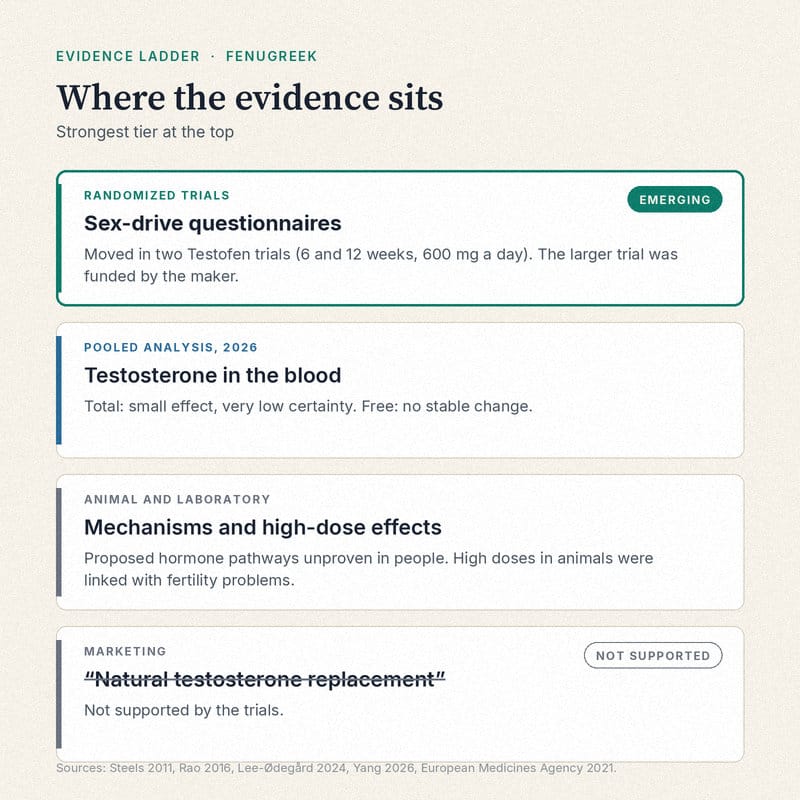
Graded strongest first: randomized controlled trials and their pooled analyses, observational studies, animal and laboratory work, then anecdote and marketing.
Randomized controlled trials: sex-drive and symptom questionnaires (the strongest human finding)
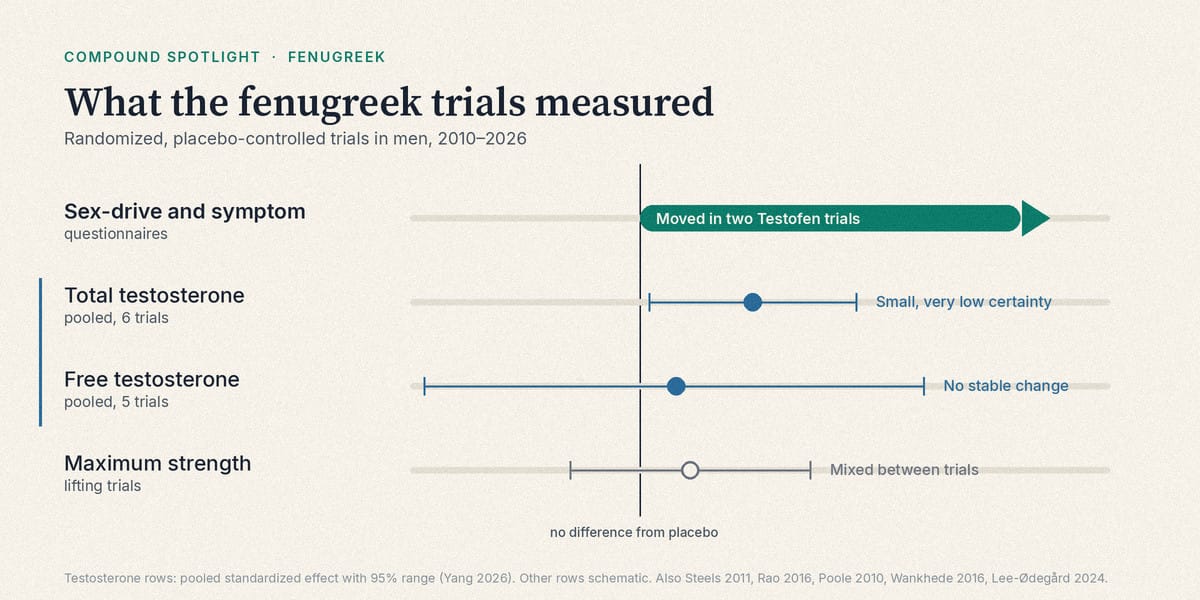
Rao and colleagues, 2016 (The Aging Male; PMID 26791805). Randomized, double-blind, placebo-controlled trial in 120 healthy men in their 40s to 70s; 111 completed. Testofen 600 mg a day for 12 weeks. The primary endpoint, the Aging Males' Symptoms scale (a 17-question checklist of mood, physical and sexual symptoms), improved more on Testofen than placebo (p = 0.013). On a secondary sexual-function questionnaire (the Derogatis Interview for Sexual Functioning, self-report version), the Testofen group's total score rose from 66.2 to 76.3 while the placebo group stayed flat (57.8 to 57.0). The published table tests that change against each group's own starting point, not directly against placebo. On Testofen, morning erections went from about one a week to two or three, and sexual activity from once or twice a month to nearly weekly. Funding: the trial products and funding were supplied by Gencor Pacific, the company that sells Testofen.
Steels and colleagues, 2011 (Phytotherapy Research; PMID 21312304). Randomized, double-blind, placebo-controlled trial in 60 healthy men aged 25 to 52 without erectile dysfunction. A Testofen-based tablet, 600 mg a day for 6 weeks. The primary endpoint was the same sexual-function questionnaire. The authors report gains in the arousal and orgasm sections and in self-rated strength, energy and well-being, with no effect on mood or sleep. Blood testosterone and prolactin stayed within the normal reference range. Two limits: the tablet combined fenugreek with minerals (a 2026 systematic review lists magnesium, zinc and vitamin B6), so the fenugreek effect cannot be separated cleanly; and the full paper is paywalled, so these results come from its abstract, which does not state funding.
Lee-Ødegård and colleagues, 2024 (PLoS One; PMID 39288153). Double-blind randomized trial in Norway; 95 men aged 40 to 80 completed 12 weeks of Trigozim at 0 (placebo), 600, 1,200 or 1,800 mg a day. Every group, placebo included, received the same vitamins and minerals (including vitamin D and zinc). The libido questionnaire showed no significant differences between groups, so a third branded extract, at up to three times the usual dose, did not repeat the questionnaire finding. Funding: commercial (Vitas Ltd); two authors hold stock in that company.
How to read this tier. Two trials of one branded extract family point the same way, and the larger met its primary endpoint: early replication within one product line, not independent confirmation. A different extract did not repeat it. The 2026 review found pooled questionnaire results leaning favorable, from few studies, and cautioned against reading them as a testosterone effect.
Randomized controlled trials and pooled analysis: testosterone in the blood
Yang and colleagues, 2026 (Frontiers in Nutrition; PMID 42688439; DOI 10.3389/fnut.2026.1903508). Registered systematic review and meta-analysis of placebo-controlled randomized trials in adult men, searched through May 2026. Thirteen studies; eight fed the hormone analysis (637 randomized men).
- Total testosterone (6 studies): standardized mean difference 0.25 (95% confidence interval 0.02 to 0.48). A small effect on a statistical scale, not a fixed number of ng/dL.
- Free testosterone (5 studies) — the unbound portion: 0.08 (95% confidence interval −0.48 to 0.63). No reliable change, and the studies disagreed with each other substantially.
- Quality: none of the 13 studies was judged low risk of bias; two were high risk. Certainty for both hormone outcomes was rated very low.
- Who paid: per the review's study table, all eight hormone-analysis trials were funded by, or linked to, a product maker (Indus Biotech, Gencor and others). The review authors declared no conflicts.
- Authors' conclusion: current evidence "does not support clinical or commercial testosterone-boosting claims."
Individual hormone results, for context:
- Rao 2016 (hormones analyzed in 97 men): total testosterone 12.3 to 13.8 nmol/L (about 355 to 398 ng/dL) on Testofen versus 13.2 to 12.4 nmol/L (about 381 to 358 ng/dL) on placebo; calculated free testosterone 241 to 264 pmol/L versus 254 to 231 pmol/L. Statistically significant, small, and partly driven by placebo drifting down.
- Lee-Ødegård 2024: blood total testosterone rose about 13% from baseline across all doses, but the difference from placebo (about 9%) was not statistically significant (p = 0.122). Saliva testosterone was 37.2% higher than placebo (p = 0.042); saliva is not the standard diagnostic test.
- Steels 2011: testosterone stayed within the reference range.
- Rao 2020 (Testofen in men with an enlarged prostate, as summarized by Yang): no improvement in total or free testosterone.
Randomized controlled trials in men who lift weights: strength and body fat
Poole and colleagues, 2010 (Journal of the International Society of Sports Nutrition; PMID 20979623). 49 resistance-trained men (average age about 21) on a supervised program took Torabolic 500 mg a day or placebo for 8 weeks. Body fat fell 2.3 percentage points versus 0.39 on placebo. Leg-press one-lift maximum rose 84.6 kg versus 48 kg, with the groups differing at week 8. Bench-press gains were 9.1 kg versus 4.3 kg, but follow-up comparisons found no difference between groups at any time point. Hormones showed no meaningful change over time, and the authors concluded the supplement had no anabolic effect on hormone status. Funding: Indus Biotech.
Wankhede and colleagues, 2016 (Journal of Sport and Health Science; PMID 30356905; corrected 2018). Pilot trial: 60 men randomized (55 analyzed), Fenu-FG 300 mg twice a day during 8 weeks of resistance training. Free testosterone rose in both groups — from 17.76 to 35.29 pg/mL on fenugreek and from 21.30 to 31.70 pg/mL on placebo — with the larger rise on fenugreek (between-group difference significant). (The original paper printed these units as ng/dL; a 2018 correction changed them to pg/mL.) Total testosterone and one-lift maximum on bench and leg press did not differ between groups. Funding: Indus Biotech; two of the three authors work for that company.
Pooled (Yang 2026, supplementary outcomes): body fat −1.37 percentage points (95% confidence interval −2.13 to −0.61) and bench-press one-lift maximum +4.86 kg (1.71 to 8.02) favored fenugreek; leg press was not stable. These rest on small, manufacturer-funded trials.
Blood sugar (a separate lane)
Gupta and colleagues, 2001 (Journal of the Association of Physicians of India; PMID 11868855; abstract). 25 people with newly diagnosed type 2 diabetes took 1 g a day of seed extract or placebo for two months. Fasting and two-hour blood sugar did not differ from placebo; the blood-sugar and insulin curve after a glucose drink was lower. The National Center for Complementary and Integrative Health says fenugreek may help lower blood sugar in type 2 diabetes, though many studies are not high quality. For men's health this matters mainly as a safety issue with diabetes medicines.
Observational studies
No meaningful observational data on fenugreek and testosterone or sexual function in men were found.
Animal and laboratory work
Proposed mechanisms (saponins such as diosgenin and protodioscin acting on the enzymes that convert testosterone or on its binding protein) are hypotheses; the 2026 review notes the human trials were not designed to test them. The European Medicines Agency notes that high doses of fenugreek seed in mice, rats and rabbits were linked with testicular toxicity and reduced fertility, and in pregnant rats and mice with fetal loss and malformations. Guinea-pig uterine tissue in the laboratory showed stimulated contractions. None of this transfers directly to men taking 600 mg a day, but it shapes the safety advice below.
Anecdote and marketing
"Natural testosterone replacement" and "a free-testosterone cure" sit here. The randomized data do not support them: the clearest human result is a questionnaire result, hormone changes are small and very uncertain, and free testosterone shows no stable change.
Current-research pass (April 2025 to October 2026)
A PubMed search for fenugreek trials and pooled analyses published April 2025 to October 2026 found:
- One new pooled analysis on this question (Yang 2026, above), the most careful so far; it narrows the claims rather than expanding them.
- No new randomized controlled trial of fenugreek for testosterone or sex drive in men.
- Liver safety: a 2026 meta-analysis of 16 controlled trials (1,171 participants) found no significant effect on standard liver enzyme tests (PMID 42558777).
- Blood sugar: two small food-based crossover studies (PMID 41038677; PMID 42738984) and a 2025 pooled analysis (PMID 41509111) point toward lower blood sugar, with wide variation between trials.
- Corrections: no retractions; one correction (the 2018 Wankhede unit fix).
Nothing in this window changes the grade.
Clinical relevance
Mechanism (labelled as mechanism). Saponin-rich extracts are proposed to act on testosterone metabolism; in people this has not been shown. Questionnaire scores moved while hormones barely changed (Rao) or stayed in normal range (Steels), so any sex-drive effect may not run through testosterone at all.
Low testosterone is a diagnosis, not a supplement target. The Endocrine Society guideline (PMID 29562364) recommends diagnosing hypogonadism only with symptoms and signs plus unequivocally, consistently low testosterone on repeated fasting morning tests. A supplement that nudges a questionnaire does not treat that condition, and low testosterone can point to problems such as sleep apnea, obesity or opioid use that need their own workup.
Interactions and cautions (from regulator and reference sources):
- Diabetes medicines: the European Medicines Agency advises close monitoring of blood sugar in people treated for diabetes because of a possible blood-sugar-lowering effect; the National Center for Complementary and Integrative Health notes large doses may cause a harmful drop in blood sugar.
- Warfarin and other blood thinners: one published case report (PMID 11310527) described a woman on warfarin whose clotting test drifted up (from her usual 2 to 3, up to 3.4) while taking boldo and fenugreek, and settled after she stopped. European assessors judged this evidence very weak; the National Library of Medicine's drugs-and-lactation reference still lists a warfarin bleeding interaction. Rao 2016 excluded men on blood thinners.
- Allergy: the European Medicines Agency lists allergy to peanut, soy or other legumes as a reason not to use fenugreek; chickpea and peanut cross-reactions and serious reactions, including asthma flares, are reported.
- Pregnancy: relevant to households. The National Center for Complementary and Integrative Health states fenugreek is not safe in pregnancy above food amounts, linking it to birth defects; the European Medicines Agency does not recommend it in pregnancy or breastfeeding.
- Liver: liver injury has been reported with fenugreek alone and in herbal combinations (National Library of Medicine), although pooled trials show no average liver-enzyme change.
- Common side effects: diarrhea, gas, nausea and dizziness. Urine and sweat can smell like maple syrup (from a compound called sotolon).
Monitoring. Trials ran 6 to 12 weeks. Lee-Ødegård 2024 saw small liver-enzyme and creatinine rises from baseline that stayed within normal limits and did not differ from placebo. There are no safety data beyond about three months.
For you (practical)
This section is education for conversations with your own physician — not a recommendation to start, stop or dose anything.
Who might discuss it with a clinician: healthy men with normal testosterone curious about a time-limited trial for sex drive, who accept that the evidence is a handful of mostly manufacturer-funded questionnaire studies.
Who probably would not benefit: men with confirmed low testosterone looking for a substitute for testosterone replacement therapy; men wanting a measurable rise in free testosterone; men hoping for muscle gain without the training, sleep and protein basics.
Questions to bring to your physician:
- "My sex drive is down. Should we check morning testosterone twice, and look at sleep, weight, alcohol, mood and my medicines, before I try a supplement?"
- "I take a diabetes medicine. Could fenugreek push my blood sugar too low, and how would we monitor it?"
- "I take warfarin or another blood thinner. Is there any reason to avoid this?"
- "I have a peanut, soy or chickpea allergy. Is fenugreek a risk for me?"
- "If I try a branded extract for 8 to 12 weeks, what would count as it working, and when should I stop?"
Literature dose ranges (study context only, not a personal dose): Testofen and Fenu-FG trials used 600 mg a day for 6 to 12 weeks; Torabolic 500 mg a day for 8 weeks; Trigozim 600 to 1,800 mg a day for 12 weeks. Blood-sugar studies used about 1 g a day of extract or grams of seed. Kitchen seed is not a standardized extract, and a multi-ingredient "testosterone booster" is not a fenugreek trial.
Talk with your physician before making changes.
Uncertainty and open questions
- Does the questionnaire effect hold up independently? The positive sex-drive data come from one manufacturer's product line, and every trial in the 2026 hormone analysis had a commercial link.
- Does it run through testosterone? Probably not mainly. Questionnaire gains appeared with hormones that stayed in normal range or moved slightly, and free testosterone pooled to no reliable change.
- Which extract, if any? Branded extracts differ in how they are made and standardized; results do not transfer automatically.
- How long and how safe? Effects and safety beyond about three months of daily use are not characterized.
- Fertility: in mice, rats and rabbits, high doses were linked with testicular harm; these trials did not study human sperm or fertility.
- Where the market has outrun the science: "natural testosterone replacement" and "free-testosterone cure" claims are not supported. The 2026 meta-analysis explicitly rejects commercial testosterone-boosting claims.
- What would change the verdict: an adequately sized, independently funded randomized controlled trial of a named extract, with a sexual-function primary endpoint compared directly against placebo, standardized morning hormone testing, and follow-up beyond six months. A clearly positive result would push toward STRONG; a clearly null one toward WEAK.
Verdict
EMERGING — In a few small, mostly manufacturer-funded randomized controlled trials, branded fenugreek extracts at about 600 mg a day improved how healthy men rated their sex drive and related symptoms, but the testosterone evidence is very low certainty, free testosterone shows no stable change, and fenugreek is not a substitute for testosterone replacement therapy.
References
- Steels E, Rao A, Vitetta L. Physiological aspects of male libido enhanced by standardized Trigonella foenum-graecum extract and mineral formulation. Phytother Res. 2011;25(9):1294-1300. PMID: 21312304. DOI: 10.1002/ptr.3360.
- Rao A, Steels E, Inder WJ, Abraham S, Vitetta L. Testofen, a specialised Trigonella foenum-graecum seed extract, in healthy aging males: a double-blind randomised clinical study. Aging Male. 2016;19(2):134-142. PMID: 26791805. DOI: 10.3109/13685538.2015.1135323.
- Poole C, Bushey B, Foster C, et al. Effects of a commercially available botanical supplement on strength, body composition, power output, and hormonal profiles in resistance-trained males. J Int Soc Sports Nutr. 2010;7:34. PMID: 20979623. DOI: 10.1186/1550-2783-7-34.
- Wankhede S, Mohan V, Thakurdesai P. Beneficial effects of fenugreek glycoside supplementation in male subjects during resistance training: a randomized controlled pilot study. J Sport Health Sci. 2016;5(2):176-182. PMID: 30356905. DOI: 10.1016/j.jshs.2014.09.005. Corrigendum: J Sport Health Sci. 2018;7(2):251. PMID: 32099715.
- Lee-Ødegård S, Gundersen TE, Drevon CA. Effect of a fenugreek extract on testosterone in blood plasma and saliva: a double-blind randomized controlled study. PLoS One. 2024;19(9):e0310170. PMID: 39288153. DOI: 10.1371/journal.pone.0310170.
- Yang P, Niu Z, Guo J, Huang T, Chang D, Huang X. Oral fenugreek-derived preparations and testosterone-related outcomes in adult men: systematic review and meta-analysis. Front Nutr. 2026;13:1903508. PMID: 42688439. DOI: 10.3389/fnut.2026.1903508.
- Gupta A, Gupta R, Lal B. Fenugreek seeds and glycaemic control and insulin resistance in type 2 diabetes: a double blind placebo controlled study. J Assoc Physicians India. 2001;49:1057-1061. PMID: 11868855.
- Bhasin S, Brito JP, Cunningham GR, et al. Testosterone therapy in men with hypogonadism: an Endocrine Society clinical practice guideline. J Clin Endocrinol Metab. 2018;103(5):1715-1744. PMID: 29562364. DOI: 10.1210/jc.2018-00229.
- Lambert JP, Cormier J. Potential interaction between warfarin and boldo-fenugreek. Pharmacotherapy. 2001;21(4):509-512. PMID: 11310527. DOI: 10.1592/phco.21.5.509.34492.
- European Medicines Agency. European Union herbal monograph on Trigonella foenum-graecum L., semen, Rev. 1 (EMA/HMPC/179591/2018, 2021) and assessment report (EMA/HMPC/179590/2018).
- National Center for Complementary and Integrative Health (NIH). Fenugreek. https://www.nccih.nih.gov/health/fenugreek
- Drugs and Lactation Database (LactMed): Fenugreek. National Library of Medicine; 2026. PMID: 30000838.
- Mohit M, et al. Fenugreek supplementation and liver function enzymes: systematic review and meta-analysis. Health Sci Rep. 2026;9(8):e72960. PMID: 42558777.
- Chehregosha F, et al. Fenugreek seed and glycemic parameters: updated meta-analysis. Avicenna J Phytomed. 2025;15(6):1677-1699. PMID: 41509111.
- Deshpande PO, et al. Fenuflakes and 24-hour glycemic variability in type 2 diabetes: randomized crossover study. Asia Pac J Clin Nutr. 2025;34(5):730-739. PMID: 41038677.
- Saeed S, et al. Sprouted fenugreek-enriched wheat flatbread and post-meal glucose in healthy adults: randomized crossover pilot. Nutrients. 2026;18(17):2811. PMID: 42738984.
Disclaimer
Vanguard Optimization provides physician-led, evidence-based education only. This monograph is not medical advice, does not diagnose or treat, and does not establish a physician–patient relationship. Compounds discussed may carry risks and interactions specific to your health. Talk with your own physician before making changes.