1. Overview
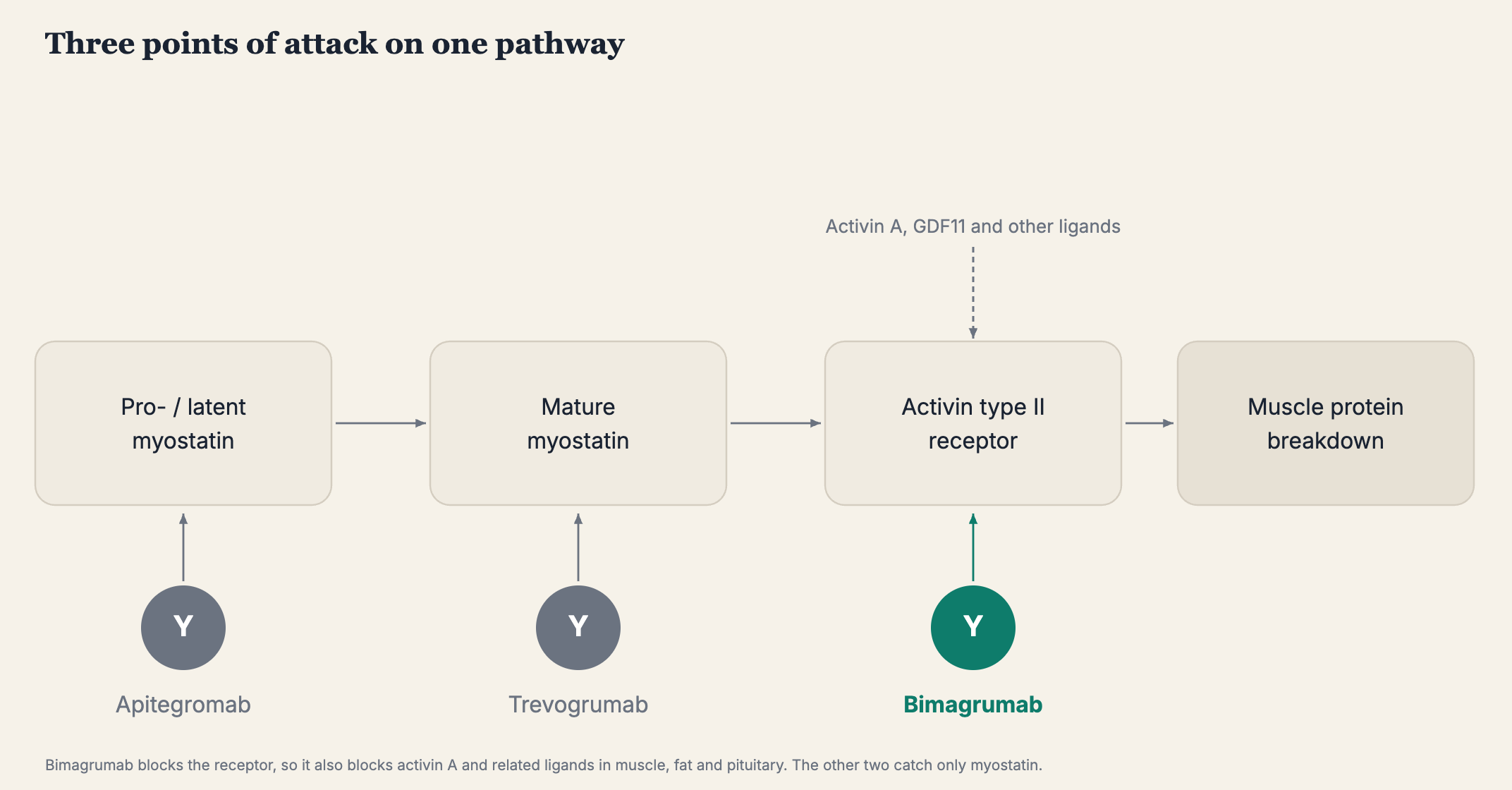
Bimagrumab is a fully human monoclonal antibody that blocks the activin type II receptors (ActRIIA and ActRIIB) on the surface of muscle, fat and other cells. Because it blocks the receptor rather than any one hormone, it shuts out everything that signals through it — myostatin, activin A, growth differentiation factor 11 and related ligands.¹ That breadth is the central fact about this drug. In the trials published so far it is the one agent in this class that both preserves lean mass and increases fat loss, and its adverse-event profile is broader than what has been reported for the ligand-selective antibodies — with the caveat that no head-to-head comparison exists.¹˒¹⁹˒²⁰
Bimagrumab was built by Novartis for muscle-wasting diseases, failed its Phase 2b trial in inclusion body myositis (a failure published in 2019), was spun out to a start-up called Versanis, and was bought by Eli Lilly in July 2023 for close to two billion dollars once the obesity angle became clear.²˒³ It is on members' radar because of BELIEVE, a 507-person Phase 2 trial published in Nature Medicine in March 2026: bimagrumab plus semaglutide produced 22% weight loss at 72 weeks, with more than 90% of that loss coming from fat — a 72-week figure that comes from an open-label, post hoc extension the authors themselves flag as not definitive.¹ Lilly is now testing a subcutaneous version with tirzepatide; results have not been released.⁴
It is an antibody given by intravenous infusion in every trial to date (every 4 weeks in most earlier studies; every 12 weeks after loading doses in BELIEVE), not a peptide, and not available outside a trial.¹˒²˒⁶
2. Evidence
2a. Randomized controlled trial evidence — BELIEVE (peer-reviewed)
Design. BELIEVE (NCT05616013) randomized 507 adults with obesity (body mass index 30 or higher, or 27 with a complication; no diabetes) at 26 sites in the US, Australia and New Zealand into nine arms of 56–57 people each: placebo; bimagrumab 10 or 30 mg/kg; semaglutide 1.0 or 2.4 mg; and the four combinations. Bimagrumab was infused at weeks 1 and 4 (loading) and then every 12 weeks; semaglutide was given open-label from commercial pens because a matching placebo was not available. The blinded primary period ran 48 weeks, followed by a 24-week open-label extension to week 72 (the placebo and low-dose bimagrumab arms switched to 30 mg/kg). Mean age was 47.5, mean weight 107.5 kg, mean body mass index 37.3; 57% were women. Everyone was counseled monthly on a 500-kcal deficit, at least 1.2 g/kg/day of protein and 150 minutes of weekly activity.¹
The primary endpoint was absolute weight change at week 48. Week-72 analyses were post hoc and nothing was adjusted for multiplicity; the authors state the results "should not be used to infer definitive treatment effects."¹
Weight. At week 48 (intention-to-treat-style estimand), weight fell 6.0–9.3 kg with bimagrumab alone, 9.8–14.2 kg with semaglutide alone, and 12.7–17.8 kg with the combinations, versus 3.3 kg with placebo; the high-dose combination beat semaglutide 2.4 mg (−17.8 vs −14.2 kg, p<0.05). At week 72 (on-treatment estimand): bimagrumab 30 mg/kg −12.0 kg (−10.8%), semaglutide 2.4 mg −16.5 kg (−15.7%), high-dose combination −24.2 kg (−22.1%). Weight loss of 15% or more at week 72 was achieved by 22%, 52% and 85% respectively.¹
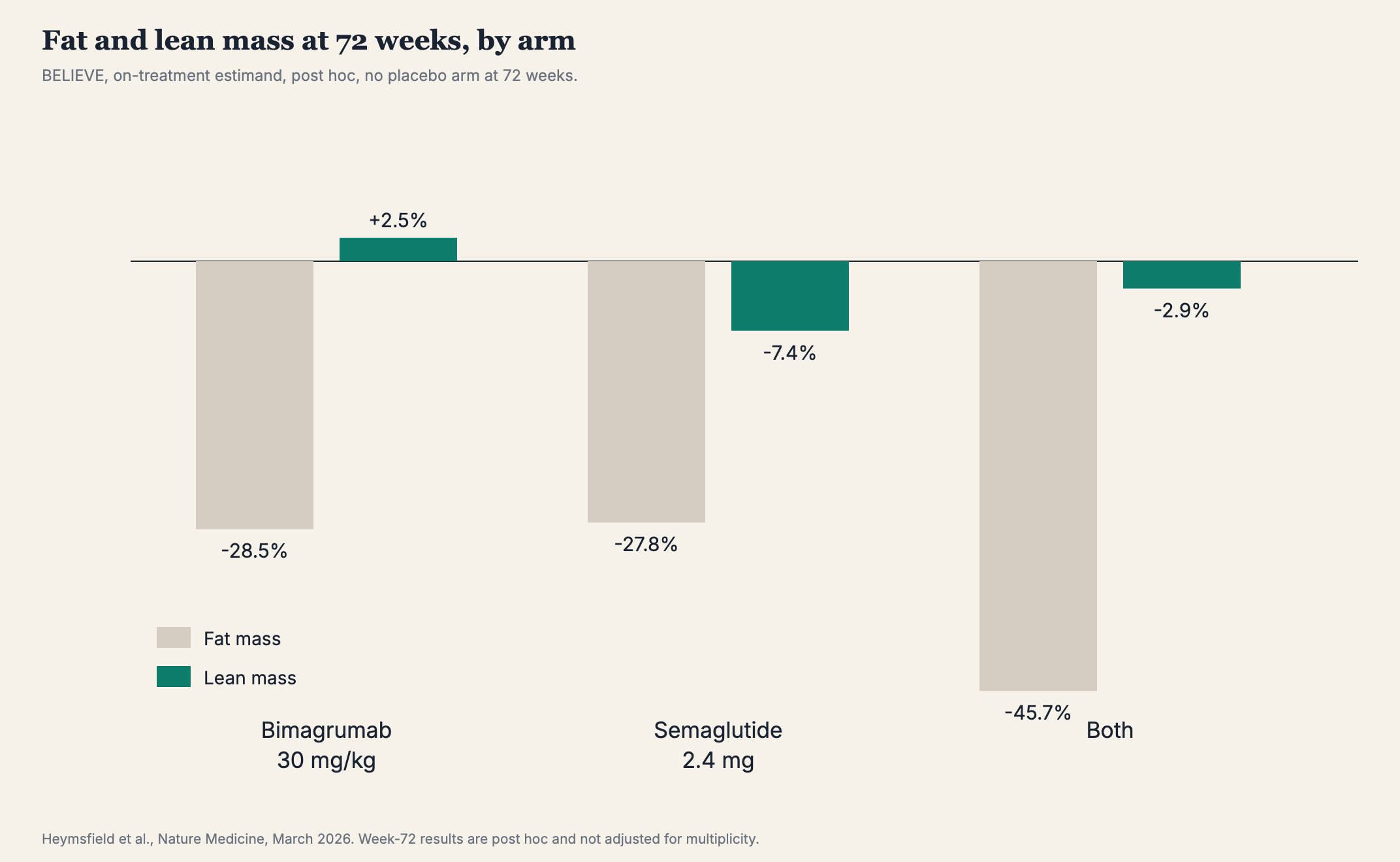
Body composition (dual-energy X-ray absorptiometry, DXA). This is where the drug differs from the ligand-selective antibodies:
| Week 72, on-treatment estimand | Bimagrumab 30 mg/kg | Semaglutide 2.4 mg | Combination (30 mg/kg + 2.4 mg) |
|---|---|---|---|
| Fat mass | −28.5% | −27.8% | −45.7% |
| Lean mass | +2.5% | −7.4% | −2.9% |
| Share of weight lost that was fat | 100% | 75.6% | 92.2% |
| Visceral fat (estimated) | −45.1% | −35.8% | −58.2% |
| Waist | −13.3 cm | −14.7 cm | −21.7 cm |
Bimagrumab alone removed as much fat as semaglutide 2.4 mg while adding lean mass; the combination's fat loss was nearly additive, which the authors note is "in the range of results reported for bariatric surgery."¹ Of the combinations, bimagrumab 30 mg/kg with the lower semaglutide dose (1.0 mg) preserved lean mass best — a hint that less semaglutide plus bimagrumab may be the better composition trade.¹
Metabolic. Hemoglobin A1c at week 72: −0.23 (bimagrumab), −0.40 (semaglutide), −0.55 points (combination). Among those with prediabetes at baseline, reversion to normal A1c by week 72 was 76%, 96% and 100% versus 53% in the original placebo group (which had itself been switched to bimagrumab 30 mg/kg at week 48). Fasting insulin fell in all active arms (combination most, −34.4 pmol/L). At week 48, adiponectin rose by 14.1–33.3 µg/ml in bimagrumab-containing arms versus 6.2–7.5 µg/ml with semaglutide alone, and at week 72 high-sensitivity C-reactive protein fell 72% with bimagrumab, 59% with semaglutide and 84% with the combination.¹
Lipids — the one metabolic result that goes the wrong way. Total and low-density lipoprotein (LDL) cholesterol rose in the first 12 weeks in every bimagrumab arm. They drifted back toward baseline only in combinations containing semaglutide 2.4 mg. At week 72, LDL was +17.6% with bimagrumab alone, −8.9% with semaglutide 2.4 mg, and +0.1% with the high-dose combination. Triglycerides fell with semaglutide and the combination (−21% and −25%) but not with bimagrumab alone (−1%).¹ A 2026 meta-analysis of four bimagrumab trials in metabolic disease confirms the LDL rise: +0.47 mmol/L (95% confidence interval 0.03 to 0.91).⁵
Bone. Total hip bone mineral density fell about 2% with semaglutide 2.4 mg and with three of the four combination arms versus 0.8% with placebo; lumbar spine and total body changed 1.1% or less.¹ The authors suggest this is "possibly related to reduced mechanical loading with weight loss" rather than to bimagrumab itself; either way, lean mass is not the only tissue at stake.¹
Function. Grip strength was an exploratory endpoint. Only one arm — bimagrumab 30 mg/kg plus semaglutide 1.0 mg — differed from placebo (+4.8 kg vs +1.7 kg, p<0.05); every other arm, including bimagrumab alone, was similar to placebo. Physical functioning on the 36-Item Short Form Health Survey did not differ from placebo at week 48. A second patient-reported physical-function scale (the Impact of Weight on Quality of Life-Lite, clinical trials version) improved more with the high-dose bimagrumab combinations.¹ The authors suggest the weak function result "may be due to the broad population studied," which was not selected for low function.¹
2b. Earlier randomized evidence
- Type 2 diabetes with obesity (2021, JAMA Network Open): 75 participants, 10 mg/kg every 4 weeks for 48 weeks. Fat mass −20.5% (−7.5 kg) versus −0.5%; lean mass +3.6% (+1.7 kg) versus −0.8%; waist −9.0 cm; hemoglobin A1c −0.76 points versus −0.04 (p=0.005); weight −6.5%. Diarrhea and muscle spasms each in 41% of bimagrumab recipients.⁶
- Sarcopenia, Phase 2b (2020): 180 adults aged 70 and older, 700 mg monthly for 6 months with diet and home exercise. Lean mass +7% versus +1% (p<0.001). The primary endpoint, the Short Physical Performance Battery, did not differ (+1.34 vs +1.03, p=0.13); neither did 6-minute walk (+24.6 vs +14.3 m, p=0.16) or gait speed.⁷ More muscle, same function.
- Sarcopenia proof-of-concept (2017): 40 adults aged 65 and older. Thigh muscle volume +8% at week 8. In the subgroup with slow baseline walking speed, gait speed improved 0.15 m/s (p=0.009) and 6-minute walk 82 m (p=0.022) at week 16.⁸ Alongside the single grip-strength arm in BELIEVE, this slow-walker subgroup of a 40-person trial is the clearest function result in the bimagrumab literature.
- Inclusion body myositis, RESILIENT Phase 2b (2019) and extension (2021): 251 participants, three doses, 52 weeks. No difference in 6-minute walk at any dose (10 mg/kg: +17.6 m, 99% confidence interval [CI] −19.6 to 54.8, p=0.22). Two-year extension showed progressive deterioration in all groups; involuntary muscle contractions in 9.6%, diarrhea 14.7%.²˒⁹ This failure is what sent the drug out of Novartis.
- Casting-induced atrophy (2017): 24 young men; a single 30 mg/kg dose after two weeks in a leg cast restored thigh muscle volume to 5.1% above pre-cast levels at 12 weeks versus −0.1% with placebo — but knee-extension strength recovered equally in both arms within six weeks.¹⁰
2c. Mechanistic evidence
In muscle, blocking the activin type II receptor removes the catabolic signal (carried through activin receptor-like kinase 4 and the SMAD2/3 transcription factors) driven by myostatin and activin A. In fat, the receptor also carries activin E signaling through activin receptor-like kinase 7, which restrains lipolysis; exome-wide human genetic analyses point to the activin E gene (INHBE) and the kinase's gene (ACVR1C) as regulators of abdominal obesity.¹ Blocking the receptor is therefore proposed to mobilize fat directly, without acting on appetite — in BELIEVE, bimagrumab alone reduced reported intake by only about 180 kcal/day at week 24, versus about 480 kcal/day with semaglutide.¹ That dual-tissue mechanism is the leading hypothesis for why bimagrumab adds fat loss where the ligand-selective antibodies, in their trials to date, did not — a mechanistic explanation, not a demonstrated cause.¹˒¹⁹˒²⁰ The same receptor is present on pituitary gonadotroph cells, which is the proposed route to the hormone effects described below.¹²
2d. Pooled and safety-specific randomized evidence
- Meta-analysis (2026, four trials, 268 participants with obesity, insulin resistance or type 2 diabetes): weight −4.85 kg; fat −4.72 kg; lean +1.66 kg (0.81 to 2.51); hemoglobin A1c −0.13%; LDL +0.47 mmol/L. Discontinuation risk ratio 5.75 (1.61–20.46); muscle spasms 10.44 (4.23–25.75); diarrhea 4.91 (2.38–10.11).⁵
- Cardiac safety (2026, Journal of Clinical Endocrinology and Metabolism): 68 healthy adults aged 60–86, 6 months of 10 mg/kg. No clinically relevant change in left-ventricular mass index (1.6 g/m², 90% CI −0.2 to 3.4) or ejection fraction (2.0%); lean mass +5.5%, fat −14%.¹¹ Reassuring on the specific worry that a muscle-growth drug might remodel the heart.
- Pituitary (2018): in healthy adults 55–75, two doses of 10 mg/kg cut follicle-stimulating hormone (FSH) by 42 IU/L in women (p<0.001) with a non-significant rise in luteinizing hormone; men were unaffected; gonadal and adrenal androgens unchanged; effects reversed as the drug cleared.¹² Free testosterone was measured in BELIEVE; the values are presented in data tables and not discussed in the main text.¹
3. Clinical relevance
How I read the mechanism. Receptor blockade is a blunter instrument than ligand capture. Bimagrumab's extra fat loss, its adiponectin rise, and its C-reactive protein fall all plausibly flow from hitting activin signaling in fat as well as muscle; its cramps, acne, FSH suppression and LDL rise plausibly flow from the same breadth — an inference, not a demonstrated cause.¹˒⁵˒¹² Trevogrumab and apitegromab, which catch only myostatin, did not add meaningful weight loss in their trials; their adverse-event profiles have so far looked closer to the background incretin's (with muscle spasms reported at higher trevogrumab doses, and somewhat more nausea, fatigue and headache with apitegromab than with tirzepatide alone), though no head-to-head comparison exists.¹⁹˒²⁰ A clinician choosing between them, if the choice ever exists, will be trading fat-loss efficacy against tolerability and hormonal and lipid effects.
Safety as published. In BELIEVE, treatment-emergent adverse events occurred in 91–98% of active-arm participants versus 75% with placebo. Serious adverse events: 8.8–12.5% with bimagrumab alone, 1.8–10.7% with semaglutide alone, 3.6–9.1% with combinations, 3.6% placebo. No deaths. Discontinuation for adverse events was highest with bimagrumab monotherapy (14.0–21.4%) versus 3.6–8.8% for semaglutide and 5.3–12.5% for combinations. Muscle spasms drove five monotherapy discontinuations; nausea drove six combination discontinuations; acne four. Three pancreatitis events were spread across placebo, bimagrumab and semaglutide arms. Laboratory changes: transient rises in the liver enzymes alanine and aspartate aminotransferase, mean increases in alkaline phosphatase and creatine kinase, lower magnesium (within normal), and lipase that rose transiently with bimagrumab but stayed elevated with semaglutide.¹ Analysts covering the data flagged the liver-enzyme and lipase findings and the discontinuation rates as reasons for caution.¹³
Dosing route matters. The authors suspect the intravenous loading schedule drove the early laboratory abnormalities and adverse events, and that subcutaneous dosing "may attenuate these effects."¹ The ongoing Lilly Phase 2 with tirzepatide uses subcutaneous bimagrumab, which Lilly has described as dosed weekly; a Phase 1 bioavailability study (n=125) completed in September 2025.⁴˒¹⁴ Until those data appear, the tolerability profile of the version Lilly actually intends to market is unknown.
The LDL question. A 17.6% LDL rise at 72 weeks with bimagrumab alone, offset only by semaglutide 2.4 mg, is the one finding that could matter for cardiovascular outcomes over years.¹˒⁵ The authors attribute part of it to high intravenous doses and promise mechanistic follow-up.¹ Any clinician would want to see it resolve before this drug reaches a cardiometabolic population.
Who it might be for. Lilly is developing it for obesity broadly, not for low-muscle patients specifically. The best lean-mass preservation among the combinations came from bimagrumab 30 mg/kg with semaglutide at the lower 1.0 mg dose, which also happened to be the one arm with a grip-strength difference.¹ Whether a lower-incretin-plus-bimagrumab strategy becomes a deliberate design choice is worth watching.
Interactions. Human data exist only with semaglutide (and tirzepatide, pending). No data with testosterone, growth hormone secretagogues, or anything else an optimization-minded reader might be taking.
4. For You (practical)
Education, not a prescription — framed as what the evidence supports discussing with your own physician:
- Not available. Bimagrumab is in Phase 2, has no regulatory filing, and Lilly has not announced a Phase 3. Nothing sold as "bimagrumab" outside a trial is the drug.¹˒⁴
- It is the one of the three that also changed the scale. In the published trials, bimagrumab is the only one of these antibodies that added fat loss and weight loss — at the price of cramps, acne, a possible LDL rise, and a 14–21% discontinuation rate for adverse events on monotherapy in the intravenous trial.¹˒¹⁹˒²⁰
- The lean-mass result stands out: +2.5% on monotherapy at 72 weeks while losing 28% of fat mass.¹ But grip strength and physical-function scores improved no more than they did with placebo in most arms. More muscle on a scan is not yet more strength in the hand.¹˒⁷
- Bone is also leaving. Hip bone density fell about 2% in a year with semaglutide, with or without bimagrumab.¹ Every participant in BELIEVE was counseled to eat at least 1.2 g/kg/day of protein and get 150 minutes of weekly activity;¹ trials measuring how much resistance training protects muscle and bone during incretin therapy are only now starting.¹⁵
- If you are a woman reading this for a partner or yourself: the FSH effect is documented in women and not men, and it reversed; it is not known what it means over years.¹²
5. Uncertainty and open questions
- Strength and function. In every trial that measured it — two sarcopenia trials, the casting study, the type 2 diabetes trial and BELIEVE — bimagrumab added muscle mass; across those and RESILIENT it has rarely added measurable strength or mobility — the exceptions being a slow-walker subgroup of one small trial (where the authors also reported increased strength) and a single arm of BELIEVE.¹˒⁷⁻¹⁰ The field has not solved this, and regulators have said they do not know what endpoint should count.¹⁶
- LDL cholesterol. A rise confirmed by meta-analysis, mechanism unclear, cardiovascular significance unknown.¹˒⁵
- Subcutaneous tolerability and the tirzepatide combination. The Phase 2 (NCT06643728; 252 enrolled) reached its primary completion date in January 2026 according to the registry, and no results have been published; the diabetes companion study was withdrawn in September 2025 for "strategic business reasons."⁴˒¹⁷ The version of the drug that matters commercially has no public data.
- Durability. BELIEVE's 32-week withdrawal follow-up to week 104 is ongoing and unreported. What happens to the regained weight — fat or muscle — is the question that decides whether this is a composition drug or just a stronger weight-loss drug.¹
- Open-label semaglutide. Participants knew whether they were getting semaglutide, which the authors concede may have driven early dropouts in the arms that were not.¹
- DXA, not magnetic resonance imaging (MRI). Earlier bimagrumab studies used MRI muscle volume; BELIEVE used DXA lean mass, which the authors note measures muscle only as part of a broader lean compartment,¹ and which other investigators describe as hydration-sensitive.²⁰ In a 101-person bioimpedance analysis in chronic kidney disease, semaglutide reduced extracellular water by about 0.9 L over 24 weeks;¹⁸ it is reasonable to infer — not shown — that some apparent lean loss on DXA is water.
- Hormones. FSH suppression in women is documented; the free-testosterone data from BELIEVE sit in data tables and are not discussed in the paper's text.¹˒¹²
- Older adults and men. The authors state subgroups by age and sex were too small to analyze.¹
- Where the optimization space has run ahead. Gray-market vendor sites list follistatin, ACE-031, growth hormone secretagogues and assorted "myostatin-inhibiting" products alongside the names of these antibodies.²¹ None of them is bimagrumab, none has the trial data described here, and the related class of activin receptor ligand traps had its own adverse-effect history (telangiectasias and blood abnormalities) that BELIEVE specifically looked for and did not find.¹
6. References
- Heymsfield SB, Aronne LJ, Montgomery P, et al. Bimagrumab plus semaglutide alone or in combination for the treatment of obesity: a randomized phase 2 trial. Nat Med. 2026 Mar 2. https://doi.org/10.1038/s41591-026-04204-0 (full text, PMC13004672).
- Hanna MG, et al. Safety and efficacy of intravenous bimagrumab in inclusion body myositis (RESILIENT): a randomised, double-blind, placebo-controlled phase 2b trial. Lancet Neurol. 2019;18(9):834-844. https://doi.org/10.1016/S1474-4422(19)30200-5
- BioSpace, 23 Jun 2025 / Benzinga, Sep 2025: Lilly acquired Versanis Bio in July 2023 for nearly $2 billion; BELIEVE originally sponsored by Versanis.
- ClinicalTrials.gov NCT06643728. A Study to Investigate Weight Management With Bimagrumab (LY3985863) and Tirzepatide, Alone or in Combination, in Adults With Obesity or Overweight. Phase 2, 252 enrolled, subcutaneous; primary completion 16 Jan 2026 per registry; active, not recruiting; no results posted as of 8 Nov 2026.
- Efficacy and Safety of Bimagrumab in Adults With Obesity and Metabolic Dysfunction: A Systematic Review and Meta-Analysis of Randomized Controlled Trials. Diabetes Obes Metab. 2026 Jul 30. https://doi.org/10.1111/dom.71156
- Heymsfield SB, Coleman LA, Miller R, et al. Effect of Bimagrumab vs Placebo on Body Fat Mass Among Adults With Type 2 Diabetes and Obesity: A Phase 2 Randomized Clinical Trial. JAMA Netw Open. 2021;4(1):e2033457. https://doi.org/10.1001/jamanetworkopen.2020.33457
- Rooks D, et al. Bimagrumab vs Optimized Standard of Care for Treatment of Sarcopenia in Community-Dwelling Older Adults: A Randomized Clinical Trial. JAMA Netw Open. 2020;3(10):e2020836. https://doi.org/10.1001/jamanetworkopen.2020.20836
- Rooks D, et al. Treatment of Sarcopenia with Bimagrumab: Results from a Phase II, Randomized, Controlled, Proof-of-Concept Study. J Am Geriatr Soc. 2017. https://doi.org/10.1111/jgs.14927
- Amato AA, et al. Efficacy and Safety of Bimagrumab in Sporadic Inclusion Body Myositis: Long-term Extension of RESILIENT. Neurology. 2021. https://doi.org/10.1212/WNL.0000000000011626
- Rooks DS, et al. Effect of bimagrumab on thigh muscle volume and composition in men with casting-induced atrophy. J Cachexia Sarcopenia Muscle. 2017. https://doi.org/10.1002/jcsm.12205
- Cardiac safety of chronic inhibition of the myostatin-activin pathway with bimagrumab in healthy older adults. J Clin Endocrinol Metab. 2026 Aug 13. https://doi.org/10.1210/clinem/dgag091
- Garito T, et al. Effects of bimagrumab, an activin receptor type II inhibitor, on pituitary neurohormonal axes. Clin Endocrinol. 2018. https://doi.org/10.1111/cen.13601
- Stocktwits, 5 Mar 2026, citing CNBC: analyst reactions to BELIEVE (Leerink Partners: "compelling" efficacy; Wolfe Research: safety and discontinuation rates); Lilly statement that further Phase 2 trials evaluate subcutaneous bimagrumab dosed weekly with or without tirzepatide. BioSpace, 23 Jun 2025: BMO note on transient alanine aminotransferase increases and more persistent lipase elevations.
- ClinicalTrials.gov NCT06890611. Phase 1 relative bioavailability study of bimagrumab test/reference material and co-formulation with tirzepatide in healthy participants. n=125; completed 26 Sep 2025.
- ClinicalTrials.gov NCT07761923. Preserving Muscle Mass During Incretin-Induced Weight Loss (INCRETraIN; official title: Resistance Exercise Training to Preserve Muscle Mass and Physical Function During Incretin-Based Weight Loss). Karolinska Institutet. Recruiting; start Oct 2026.
- Society on Cachexia and Wasting Disorders. Muscle Loss in Obesity Therapy as a Therapeutic Target: Trial Design and Endpoints for Regulatory Discussions. J Cachexia Sarcopenia Muscle. 2025 Dec. https://doi.org/10.1002/jcsm.70147
- ClinicalTrials.gov NCT06901349 (withdrawn); Benzinga / BioPharma Dive, Sep 2025: Lilly ended the type 2 diabetes bimagrumab–tirzepatide Phase 2 for "strategic business reasons."
- Effects of Semaglutide on Body Composition and GFR: A Prespecified Analysis of the SMART Trial. Clin J Am Soc Nephrol. 2026. https://doi.org/10.2215/CJN.0000001051 (n=101, chronic kidney disease with overweight/obesity; bioimpedance spectroscopy).
- Regeneron Pharmaceuticals. COURAGE press releases, 17 Sep 2025 and 1 Oct 2026 (trevogrumab plus semaglutide: lean-mass preservation without added weight loss at 25–75 mg; adverse events tracking semaglutide).
- Pratley RE, et al. Apitegromab for lean mass preservation during tirzepatide-induced weight loss: a randomized, double-blind, placebo-controlled phase 2 trial. Nat Med. 2026. https://doi.org/10.1038/s41591-026-04440-4 (no added weight loss; adverse events similar to tirzepatide alone; DXA hydration limitation).
- Gray-market peptide vendor and "protocol" sites indexed in 2026 (e.g., peptideprotocolwiki.com; peptidesfromchina.co; klow-peptide.com).
7. Disclaimer
This monograph is physician-led educational content. It is not medical advice, and it does not diagnose, treat, or establish a doctor-patient relationship. Compounds discussed may carry risks and interactions specific to your health. Bimagrumab is an investigational drug that is not approved for any use. Talk with your own physician before making changes.