
1. Overview
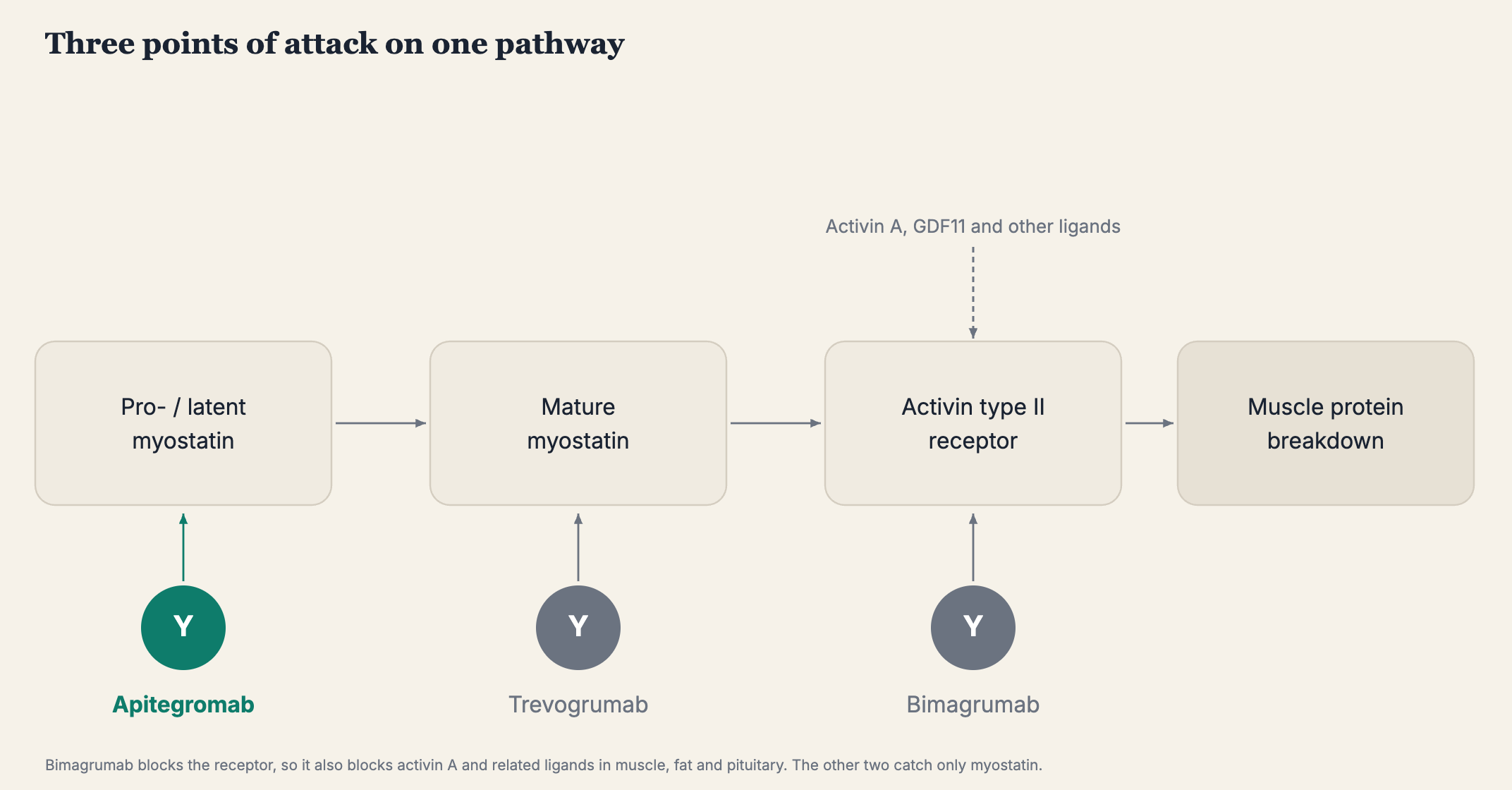
Apitegromab is a fully human monoclonal antibody from Scholar Rock that binds the inactive precursor forms of myostatin — the pro- and latent forms — and prevents them from being converted into the active hormone. According to the trial investigators it has no activity toward other members of the transforming growth factor-beta family, which distinguishes it from drugs that neutralize the mature hormone or block its receptor.¹ On 11 September 2026 the US Food and Drug Administration (FDA) approved it under the brand name Isembyld (apitegromab-mstn) for spinal muscular atrophy — by Scholar Rock's account the first regulatory approval of a myostatin inhibitor anywhere; the FDA's own release frames it as the first therapy to target muscle loss in that disease — in people aged 2 and older who are already on a survival motor neuron 2 (SMN2)-targeted therapy such as nusinersen or risdiplam.²˒³
That approval has nothing to do with weight loss, and apitegromab is not approved for muscle preservation. It is on members' radar because of EMBRAZE, a 24-week Phase 2 trial published in Nature Medicine in June 2026, in which adding apitegromab to tirzepatide cut lean-mass loss roughly in half without changing total weight loss.¹ EMBRAZE is the smallest and shortest of the three antibody trials in this space. It and BELIEVE (bimagrumab) are peer-reviewed in full; the trevogrumab trial remains press-release data awaiting its Lancet publication.⁶˒¹⁴
Apitegromab is an antibody, given by intravenous infusion every four weeks in the trials to date. It is not a peptide.¹
2. Evidence
2a. Randomized controlled trial evidence — EMBRAZE (peer-reviewed)
Design. EMBRAZE (NCT06445075) randomized 102 adults 1:1 at seven US sites between June and September 2024 to apitegromab 10 mg/kg intravenously every 4 weeks plus tirzepatide, or placebo infusions plus tirzepatide, for 24 weeks. Tirzepatide was titrated from 2.5 mg weekly by 2.5 mg every four weeks toward 15 mg. Participants were 18–65 with a body mass index of 30–45, or 27 to under 30 with a weight-related condition; anyone with diabetes, any history of cardiovascular disease, uncontrolled hypertension, hypogonadism, neuromuscular disease, kidney disease, or recent use of anabolic agents was excluded. The population was 82% women, mean age 43–44, mean weight 93 kg (apitegromab) and 99 kg (placebo). The primary analysis used completers with a week-24 dual-energy X-ray absorptiometry (DXA) scan (43 vs 44).¹
A critical methodological detail: the trial was powered at 75% to detect a 2 kg difference and used a two-sided significance level of 0.20 with 80% confidence intervals, with no adjustment for multiplicity. The authors are explicit that confidence-interval (CI) widths "must be interpreted only within that context."¹ This is a proof-of-concept design, not a confirmatory one.
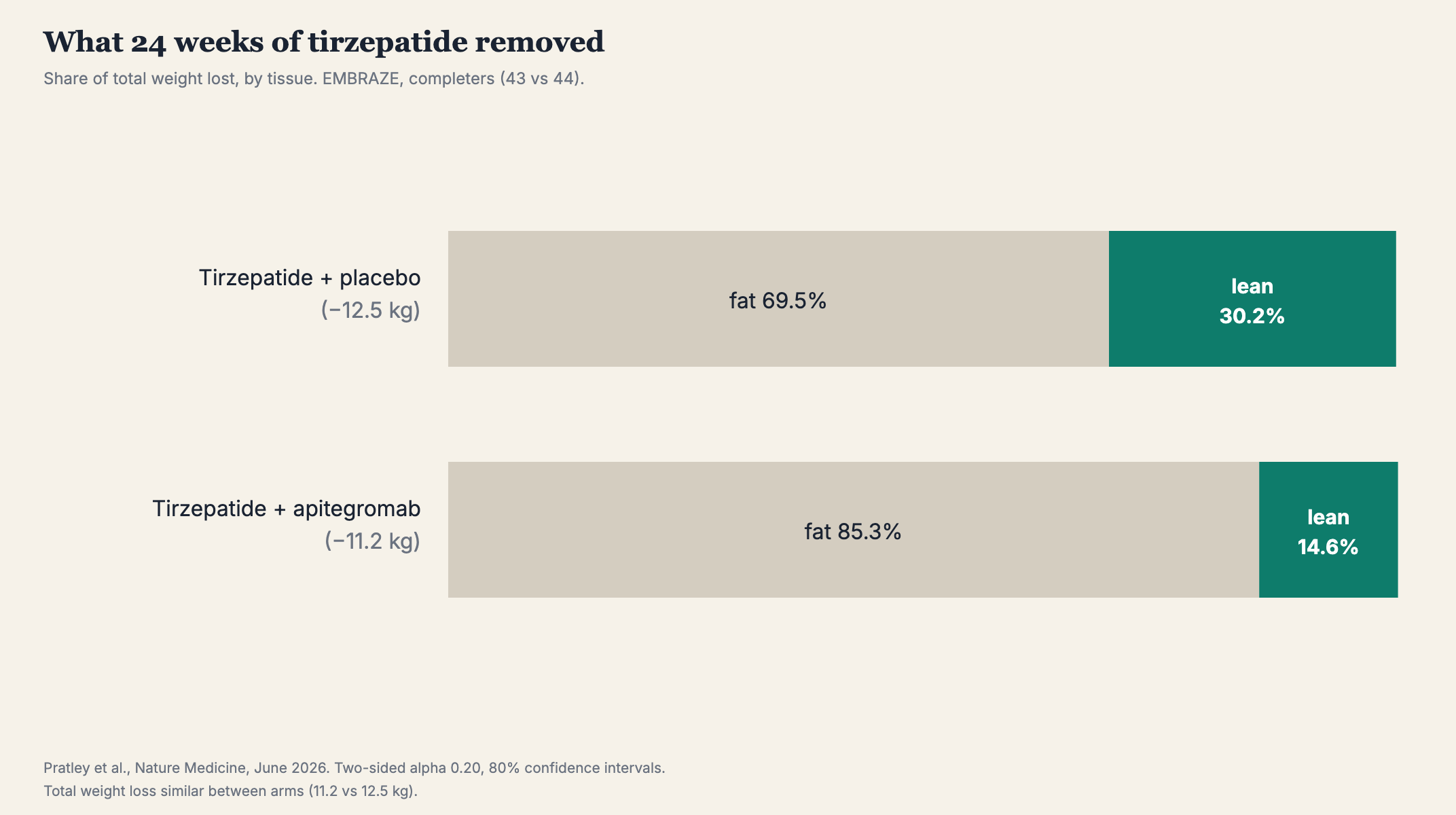
Primary result. At week 24, lean mass fell 1.6 kg (80% CI 0.8–2.3) with apitegromab versus 3.5 kg (2.8–4.1) with placebo. The difference — 1.9 kg (1.2–2.7), nominal p=0.0014 — is reported as "54.9% retention of lean mass relative to placebo."¹ Total weight loss was similar: 11.2 kg (9.6–12.7) with apitegromab versus 12.5 kg (11.1–13.9) with placebo. The composition of the loss changed: lean tissue accounted for 14.6% of weight lost with apitegromab versus 30.2% with placebo; fat loss was 8.5 kg (85.3% of the total) versus 8.0 kg (69.5%).¹
Read plainly: tirzepatide alone cost these participants three and a half kilograms of lean mass in six months; apitegromab held that to 1.6 kilograms. Participants lost only half a kilogram more fat in absolute terms, a difference within the noise of the measurement, and did not lose more weight.¹
Durability. An exploratory DXA at week 32, eight weeks after both drugs were stopped, showed the lean-mass difference had shrunk to 0.9 kg (0.3–1.5; nominal p=0.048). The effect persisted but was fading.¹
Function and metabolism. The trial prespecified exploratory physical-function measures (handheld dynamometry for force, chair sit-to-stand repetitions) and cardiometabolic markers at weeks 24 and 32. The paper reports "no notable differences" between arms on any of them.¹ The retained lean mass did not translate into measurable strength or metabolic benefit over six months.
Pharmacodynamics. Serum latent myostatin rose after the first dose and plateaued around week 16, demonstrating target engagement; trough apitegromab varied more than two-fold between participants with minimal difference in latent myostatin, indicating target saturation at 10 mg/kg.¹
2b. Randomized evidence in spinal muscular atrophy
The Phase 3 SAPPHIRE trial (NCT05156320) was a 52-week, randomized, placebo-controlled trial in 188 nonambulatory participants with 5q spinal muscular atrophy aged 2–21, all on nusinersen or risdiplam, and showed added motor-function gains on top of SMN2-targeted therapy; the FDA approval rested on these Phase 3 data, following the earlier Phase 2 TOPAZ study.²˒³˒⁴ This is relevant to a men's-health reader only as proof that the molecule does something functional in a human muscle disease, in a population that is young, neurologically impaired, and starting from very low muscle. It says little about adults with obesity.
2c. Mechanistic and animal evidence
Myostatin is a transforming growth factor-beta family ligand that regulates catabolism of skeletal muscle. In mouse models of muscle atrophy, apitegromab increased lean mass, muscle size and muscle force.¹ The paper's authors make an argument worth quoting in spirit: decades of myostatin-targeting programs failed because of off-target effects from poor selectivity or because they were tested in the wrong disease; binding the latent precursor rather than the mature ligand or the receptor is their answer to the first problem.¹ That is a plausible mechanistic claim, not an outcome.
2d. The next-generation molecule
SRK-439 is Scholar Rock's follow-on anti-myostatin antibody "optimized for cardiometabolic disorders." Preclinical data (company press release, 2024) show lean-mass preservation during glucagon-like peptide-1 (GLP-1) weight loss and reduced fat regain after GLP-1 withdrawal in animals. A Phase 1 study in healthy volunteers is ongoing with topline data expected late 2026.⁵ Animal data only; no human efficacy data exist.
3. Clinical relevance
Mechanism in context. Of the three antibodies in this space, apitegromab acts furthest upstream and, by its developer's account, most narrowly. Bimagrumab blocks the shared activin type II receptor and therefore also blocks activin A and other ligands in muscle, fat and the pituitary; the plausible mechanistic reading — inference, not demonstrated causation — is that this breadth explains both its added fat loss and its reported muscle cramps, acne, and the reversible drop in follicle-stimulating hormone seen in women.⁶˒⁷ Trevogrumab neutralizes mature myostatin. Apitegromab binds the precursor. What EMBRAZE actually showed is consistent with a narrow effect: lean mass was retained and nothing else measured changed — including, so far, strength.¹
Safety as published. Adverse events were 76% (39/51) with apitegromab versus 71% (36/51) with placebo, mostly gastrointestinal and consistent with the known profile of tirzepatide. Nausea, fatigue and headache were at least 5 percentage points more common with apitegromab. One serious adverse event per arm; discontinuations 2/51 versus 3/51, none judged related to apitegromab. One apitegromab participant stopped after a creatine phosphokinase rise that followed starting a vigorous strength-training program — attributed to the exercise, but a reminder that creatine kinase monitoring was built into the protocol. No Hy's law liver cases, no corrected QT interval above 480 ms at any timepoint, 6% transient low-titer anti-drug antibodies with no clinical consequence.¹ Across 24 weeks in 51 people nothing of concern emerged, with the caveat that 24 weeks in 51 people cannot rule out anything uncommon.
Does the FDA approval change anything for adults on a GLP-1 drug? Practically, it means a prescribing label and a commercial supply now exist. It does not mean the drug has been evaluated for this use. The approved population is children and young adults with a neuromuscular disease; the dose (10 or 20 mg/kg intravenously every four weeks) requires infusion-center logistics; and off-label use for body composition would be unlikely to be covered by insurance, expensive, and supported by a single 24-week trial with a 0.20 alpha.¹⁻³ Scholar Rock has said it "plans to engage with the FDA and EMA [European Medicines Agency] to align on the development path following the regulatory approvals of apitegromab for SMA [spinal muscular atrophy]"; no Phase 3 in obesity has been announced.⁸
Who was not studied. Men (18% of the trial), anyone over 65, anyone with diabetes or cardiovascular disease, and anyone starting with low muscle mass — in other words, most of the people for whom lean-mass preservation would matter clinically.¹
Interactions. Tested only alongside tirzepatide; no human data with semaglutide or any other agent.¹
4. For You (practical)
Education, not a prescription — framed as what the evidence supports discussing with your own physician:
- It is approved, but not for this. Isembyld exists for spinal muscular atrophy. There is no approved, insured, or studied path to using it for muscle preservation on a GLP-1 drug beyond one 24-week trial of 102 people.¹⁻³
- The effect is modest, and preliminary. About 1.9 kg of lean mass retained over six months at a 0.20 significance threshold, fading toward 0.9 kg two months after stopping, with no measurable change in strength, sit-to-stand performance, or metabolic markers.¹
- Weight loss did not improve. Total weight loss was similar in both arms, so this trial gives no reason to expect apitegromab to make tirzepatide remove more weight; what it changed was the mix of what was lost.¹
- Lifting and protein remain the background, not the experiment. EMBRAZE counseled participants on diet, physical activity and behavior change but did not measure what they did; BELIEVE specified at least 1.2 g/kg/day of protein and 150 minutes of weekly activity for everyone.¹˒⁶ No trial has yet measured how much resistance training protects muscle during incretin therapy specifically; the first such trials are only now beginning.⁹
- Watch SRK-439 as the molecule Scholar Rock appears to be positioning for this indication, rather than apitegromab itself.⁵
5. Uncertainty and open questions
- Statistical design. Alpha 0.20, 80% confidence intervals, completer analysis, 75% power, 102 participants. The authors call it proof of concept and so should we. A result this size at this alpha needs a confirmatory trial before it means anything clinically.¹
- No function benefit. The prespecified exploratory strength and sit-to-stand endpoints were null. The entire premise of muscle preservation is that muscle does something; EMBRAZE did not show that it did, over six months.¹
- Wrong population for the question. 82% women, mean age 43, no diabetes, no cardiovascular disease, no low-muscle-mass enrichment. Generalization to older men on a GLP-1 drug is extrapolation.¹
- Durability. Half the effect was gone eight weeks after stopping. Whether lifelong infusions would be required — and what that would cost — is unknown.¹
- DXA, not muscle. Lean mass by DXA includes water and organs and is hydration-sensitive, as the authors acknowledge. No magnetic resonance imaging substudy was done.¹ In a 101-person bioimpedance analysis of adults with chronic kidney disease, semaglutide reduced extracellular water by about 0.9 L over 24 weeks;¹⁰ it is reasonable to infer — though not shown — that some of the apparent lean loss on DXA in incretin trials is water rather than muscle.
- Is the problem as large as claimed? The 25–40% lean-share figure is well replicated in trial DXA data,¹˒⁶ but observational bioimpedance work presented at the 2026 European Congress on Obesity found relative muscle mass preserved or increased in more than 70% of GLP-1 users.¹¹ The harm is probably real and probably smaller and more heterogeneous than the headlines.
- Regulatory endpoint. The FDA and academic experts have said openly that they do not yet know what structural, functional or patient-reported endpoint should define success for a muscle-protective adjunct to obesity drugs.¹²
- Where the optimization space has run ahead. "Myostatin inhibitor" has become a search term in the gray-market peptide world, where vendor sites list follistatin, ACE-031, growth hormone secretagogues and newer synthetic peptides alongside the names of these antibodies.¹³ None of it is apitegromab, and apitegromab itself has one small trial in this setting.
6. References
- Pratley RE, Denham DS, Trivedi R, et al. Apitegromab for lean mass preservation during tirzepatide-induced weight loss: a randomized, double-blind, placebo-controlled phase 2 trial. Nat Med. 2026 Jun 8. https://doi.org/10.1038/s41591-026-04440-4 (full text, PMC13375528).
- US Food and Drug Administration. FDA approves first therapy to target muscle loss in spinal muscular atrophy. News release, 11 Sep 2026.
- Scholar Rock. Scholar Rock Announces FDA Approval of ISEMBYLD (apitegromab-mstn). Press release, 11 Sep 2026; coverage in NeurologyLive (11 Sep 2026), Pharmacy Times and Contemporary Pediatrics (14 Sep 2026), Consultant360, including dosing (10 or 20 mg/kg intravenously every 4 weeks). Complete response letter received September 2025 for manufacturing issues at the Catalent Indiana fill-finish site, with no safety or efficacy concerns raised (Scholar Rock, Jan 2026; SMA News Today, 17 Nov 2025).
- Crawford TO, Servais L, Mercuri E, et al. Safety and efficacy of apitegromab in nonambulatory type 2 or type 3 spinal muscular atrophy (SAPPHIRE): a phase 3, double-blind, randomised, placebo-controlled trial. Lancet Neurol. 2025;24(9):727-739. https://doi.org/10.1016/S1474-4422(25)00225-X
- Scholar Rock. New SRK-439 Preclinical Data Showing Significant Lean Mass Preservation and Attenuation of Fat Mass Rebound Following GLP-1 Receptor Agonist Withdrawal. BusinessWire, 24 Jun 2024; Scholar Rock Second Quarter 2026 financial results press release (Phase 1 in healthy volunteers ongoing, topline late 2026).
- Heymsfield SB, et al. Bimagrumab plus semaglutide alone or in combination for the treatment of obesity: a randomized phase 2 trial. Nat Med. 2026 Mar 2. https://doi.org/10.1038/s41591-026-04204-0
- Garito T, et al. Effects of bimagrumab, an activin receptor type II inhibitor, on pituitary neurohormonal axes. Clin Endocrinol. 2018. https://doi.org/10.1111/cen.13601
- Scholar Rock. Form 8-K, third quarter 2026 (US Securities and Exchange Commission, exhibit 99.1): "plans to engage with the FDA and EMA to align on the development path following the regulatory approvals of apitegromab for SMA [spinal muscular atrophy]"; Phase 2 FORGE study in facioscapulohumeral muscular dystrophy initiated.
- ClinicalTrials.gov NCT07761923. Preserving Muscle Mass During Incretin-Induced Weight Loss (INCRETraIN; official title: Resistance Exercise Training to Preserve Muscle Mass and Physical Function During Incretin-Based Weight Loss). Karolinska Institutet. Recruiting; start Oct 2026.
- Effects of Semaglutide on Body Composition and GFR: A Prespecified Analysis of the SMART Trial. Clin J Am Soc Nephrol. 2026. https://doi.org/10.2215/CJN.0000001051 (n=101, chronic kidney disease with overweight/obesity; bioimpedance spectroscopy).
- European Congress on Obesity 2026, bioimpedance cohort (reported by Medical Xpress, May 2026). Conference abstract; observational.
- Society on Cachexia and Wasting Disorders. Muscle Loss in Obesity Therapy as a Therapeutic Target: Trial Design and Endpoints for Regulatory Discussions. J Cachexia Sarcopenia Muscle. 2025 Dec. https://doi.org/10.1002/jcsm.70147
- Gray-market peptide vendor and "protocol" sites indexed in 2026 (e.g., peptideprotocolwiki.com; peptidesfromchina.co; klow-peptide.com) listing follistatin, ACE-031, growth hormone secretagogues and synthetic peptides alongside references to trevogrumab, bimagrumab and apitegromab.
- Regeneron Pharmaceuticals. Phase 2 COURAGE Trial Confirms Trevogrumab Prevents Lean Mass and Muscle Loss During GLP-1 Receptor Agonist-induced Weight Loss. Press release, 1 Oct 2026 ("in press with The Lancet").
7. Disclaimer
This monograph is physician-led educational content. It is not medical advice, and it does not diagnose, treat, or establish a doctor-patient relationship. Compounds discussed may carry risks and interactions specific to your health. Apitegromab is approved only for spinal muscular atrophy and has not been approved or adequately studied for muscle preservation during weight loss. Talk with your own physician before making changes.